A personal guarantee form is an important legal document that makes an individual personally responsible for another party’s debt or financial obligations if the primary borrower fails to pay. It is commonly used for business loans, commercial leases, equipment financing, and supplier credit agreements. By signing this document, a guarantor agrees to provide an additional layer of financial security to the lender or creditor.
Whether you are a business owner, landlord, lender, or individual considering becoming a guarantor, understanding how this agreement works is essential. A well-prepared personal guarantee agreement identifies the parties, describes the covered obligation, explains the guarantor’s responsibilities, and establishes the conditions for enforcement.
In this guide, you will learn what a personal guarantee form includes, explore common types, understand the potential risks, and discover how to prepare a practical agreement. You can also use the printable templates below as a starting point when organizing your guarantee documentation.
What Is a Personal Guarantee Form?
A personal guarantee form is a written agreement in which an individual, known as the guarantor, promises to fulfill another person’s or business’s financial obligation if the primary borrower defaults. It gives the creditor an additional party to pursue for repayment, subject to the agreement’s terms and applicable law.
For example, a small business may apply for financing but lack sufficient credit history or business assets. The lender may require the business owner to sign a personal guarantee before approving the loan. If the company cannot repay the outstanding balance, the lender may seek payment from the owner’s personal assets, depending on the agreement and applicable legal procedures.
A typical personal guarantee agreement identifies three main parties:
- Guarantor: The individual who accepts personal responsibility for the covered obligation.
- Borrower: The person or business originally responsible for repaying the debt.
- Lender or creditor: The party providing financing, credit, property, or services.
The agreement should clearly describe the underlying debt, the extent of the guarantee, and the circumstances under which the creditor can demand payment.
When Is a Personal Guarantee Form Used?
A personal guarantee is commonly requested when a lender or creditor wants additional protection against potential financial losses. It is particularly useful when the primary borrower has limited financial resources, insufficient credit history, or an uncertain repayment record.
1. Small Business and Startup Loans
New businesses may not have enough operating history, collateral, or established credit to qualify for financing independently. Banks and other commercial lenders may therefore request a personal guarantee from the business owner, director, or major shareholder.
This arrangement gives the lender another potential source of repayment if the business defaults on its loan.
2. Commercial Leases
Commercial landlords sometimes require business owners to sign a personal guarantee before approving a rental agreement. The guarantor may become responsible for unpaid rent, property damage obligations, or other covered lease liabilities.
This requirement is particularly common when a newly established company rents office, retail, or warehouse space.
3. Equipment Financing and Rentals
Companies that lease expensive equipment, machinery, or commercial vehicles may be asked to provide a personal guarantee. The agreement helps protect the equipment provider if the business fails to meet its payment obligations.
4. Supplier and Vendor Credit
Suppliers may extend payment terms to businesses that purchase inventory or materials on credit. A personal guarantee can provide additional security when the supplier is concerned about the customer’s ability to pay invoices on time.
5. Individual Loans and Co-Signing
An individual may guarantee another person’s financial obligation, such as a loan or rental agreement. For example, a family member might agree to guarantee a relative’s rental payments when the applicant does not meet the landlord’s financial requirements.
Types of Personal Guarantee Agreements
Not every personal guarantee creates the same level of financial responsibility. Understanding the different types can help both creditors and guarantors determine which arrangement is appropriate.
Limited Personal Guarantee
A limited personal guarantee places a specific restriction on the guarantor’s liability. The maximum responsibility may be expressed as a fixed dollar amount, a percentage of the debt, or a defined period.
For example, a lender may require a business owner to guarantee up to $25,000 of a $100,000 business loan. If the agreement is properly drafted, the guarantor’s liability is limited according to the specified terms.
This arrangement can help reduce financial exposure while still providing the creditor with additional protection.
Unlimited Personal Guarantee
An unlimited personal guarantee generally covers the full amount of the obligations described in the agreement. Depending on its wording, this may include outstanding principal, interest, collection expenses, legal fees, and other permitted costs.
Because the potential financial exposure can be substantial, guarantors should carefully review the agreement before signing.
Secured Personal Guarantee
A secured personal guarantee involves additional security, such as a specified asset or collateral, to support the guarantor’s obligation. The agreement should clearly identify the collateral and explain how it may be enforced following a default.
Depending on the legal structure, a separate security agreement or other documentation may also be necessary.
Unsecured Personal Guarantee
An unsecured personal guarantee does not specifically pledge a particular asset as collateral. Instead, the creditor relies on the guarantor’s contractual promise and may pursue lawful collection remedies if the borrower defaults.
Although no specific asset is pledged in advance, an unsecured guarantee does not mean personal assets are automatically protected from every possible collection action.
Joint and Several Personal Guarantee
A joint and several guarantee involves two or more guarantors who accept responsibility for the same obligation. Depending on the agreement and applicable law, the creditor may be able to pursue any one guarantor for the entire covered debt rather than only that person’s proportional share.
Each guarantor should understand this provision before agreeing to sign.
What Should a Personal Guarantee Form Include?
A clear personal guarantee form should contain enough information to identify the parties, define the obligation, and explain the guarantor’s responsibilities. Although requirements vary by jurisdiction and transaction, the following sections are commonly included.
- Agreement date: The date on which the personal guarantee is executed.
- Guarantor information: The guarantor’s full legal name, address, and relevant contact details.
- Borrower information: The legal name and address of the individual or business receiving credit.
- Lender information: The name and contact details of the creditor or financing institution.
- Underlying obligation: A description of the loan, lease, credit facility, or other financial commitment.
- Guaranteed amount: The maximum amount covered, if the guarantee is limited.
- Guarantee terms: The conditions defining when and how the guarantor becomes responsible.
- Default provisions: The events that constitute a default and the creditor’s available remedies.
- Duration and termination: The effective period and any conditions for ending the guarantee.
- Governing law: The applicable jurisdiction governing the agreement.
- Signatures: The required signatures and execution dates for the relevant parties.
Including these details helps reduce misunderstandings and makes the document easier to review. Any additional clauses should be tailored to the specific transaction rather than copied without considering their legal effect.
Free Personal Guarantee Form Template
If you need a starting point for preparing a guarantee agreement, a printable personal guarantee form template can help organize the necessary information. The following example illustrates a general document structure that can be adapted to different business and financial arrangements.
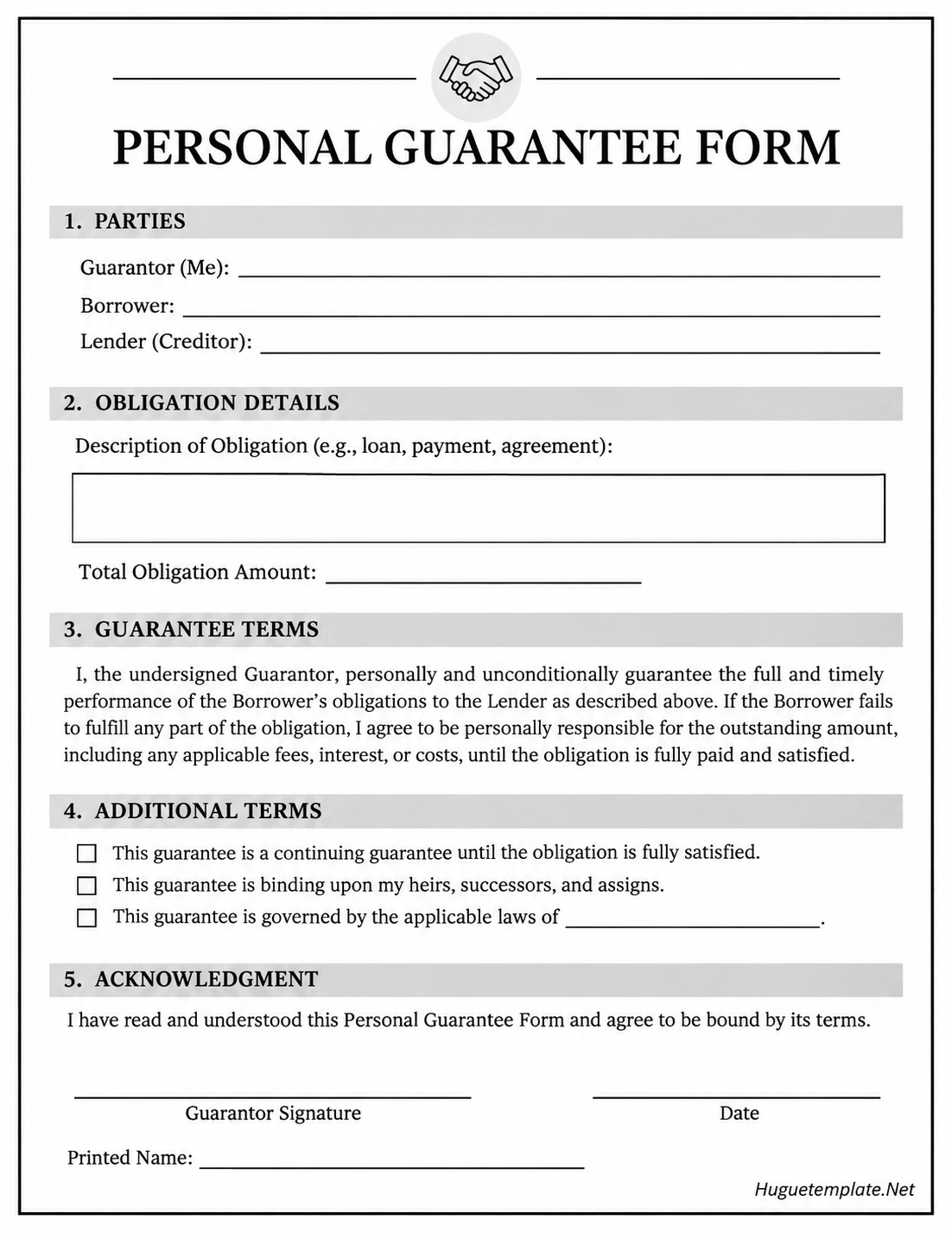
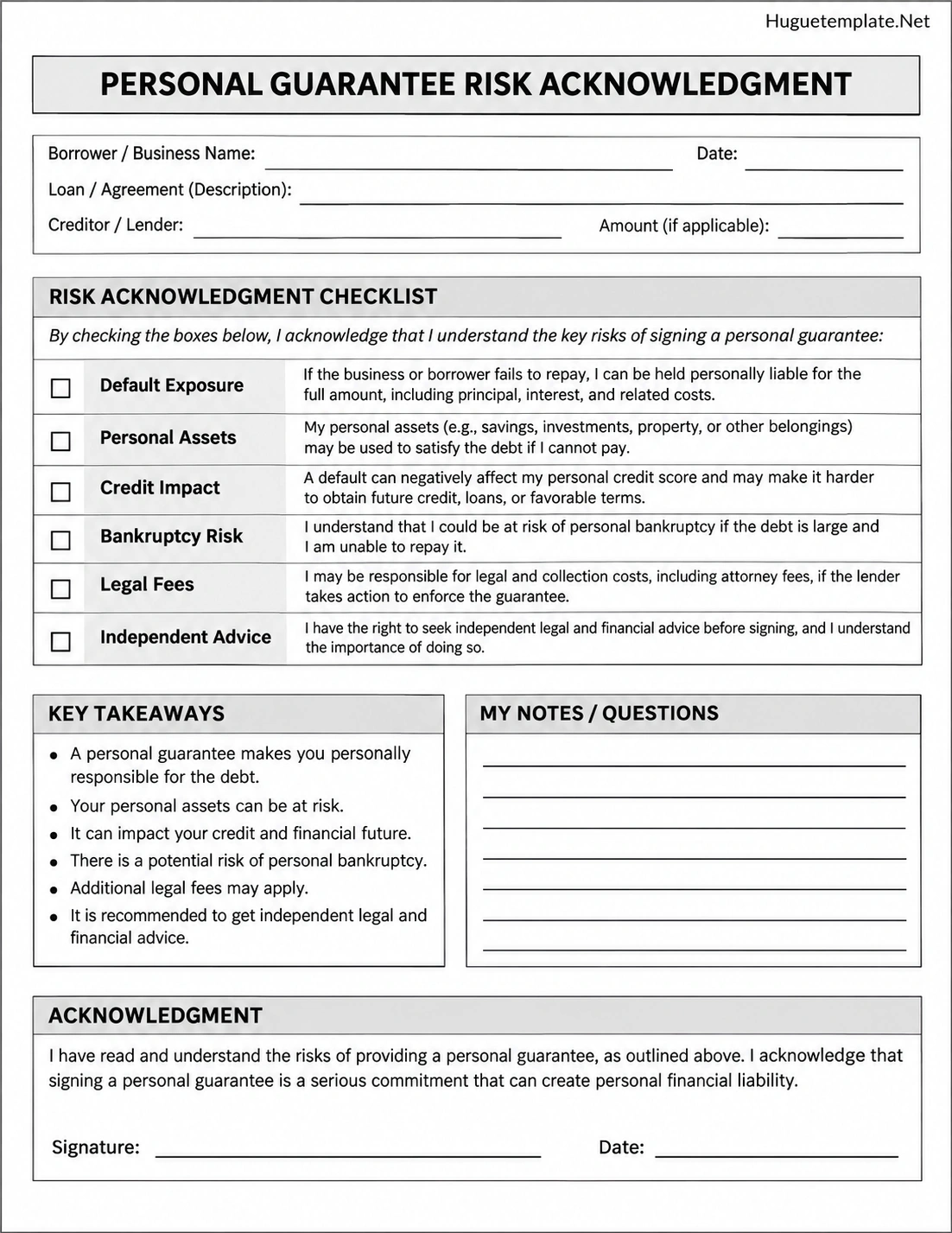
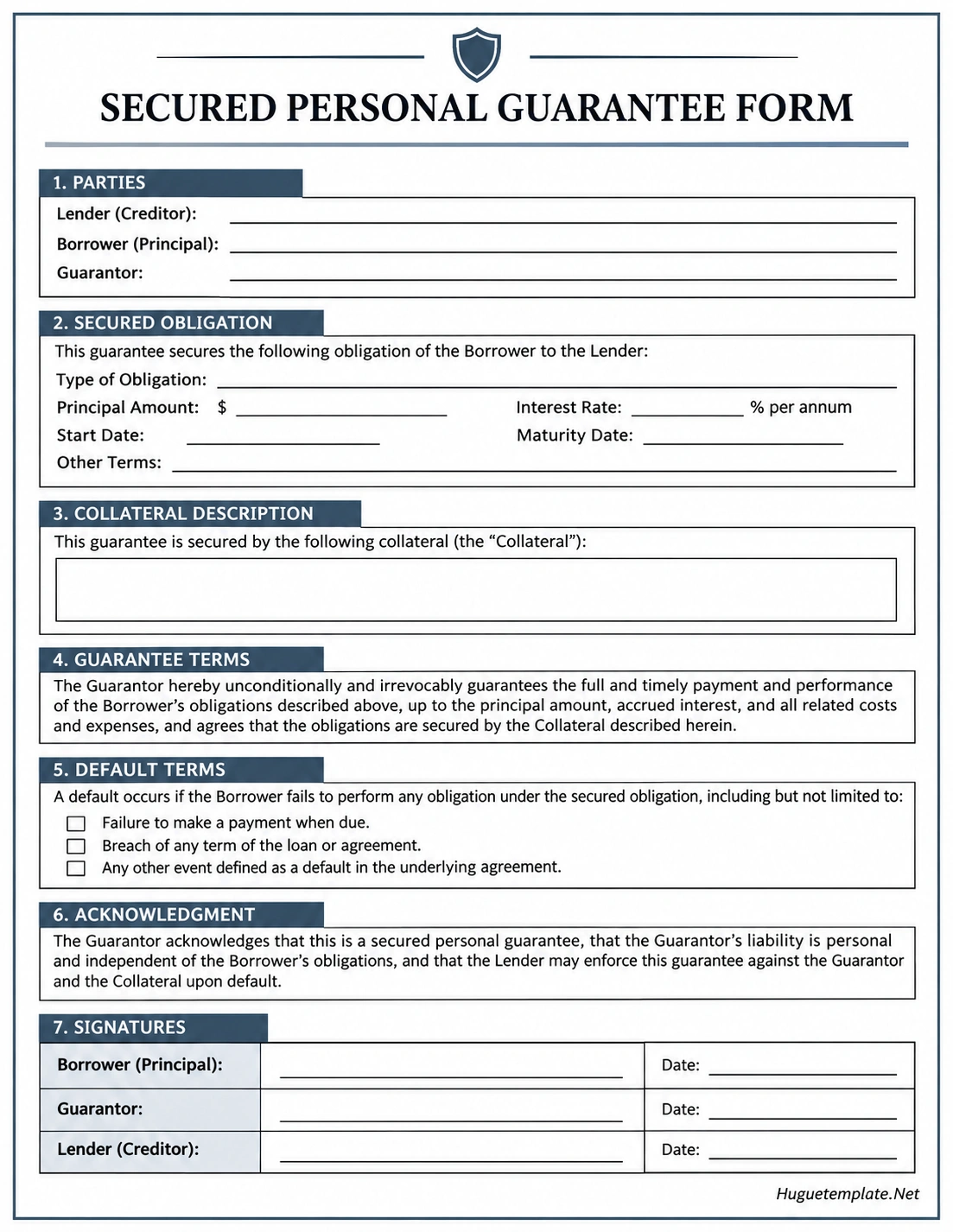
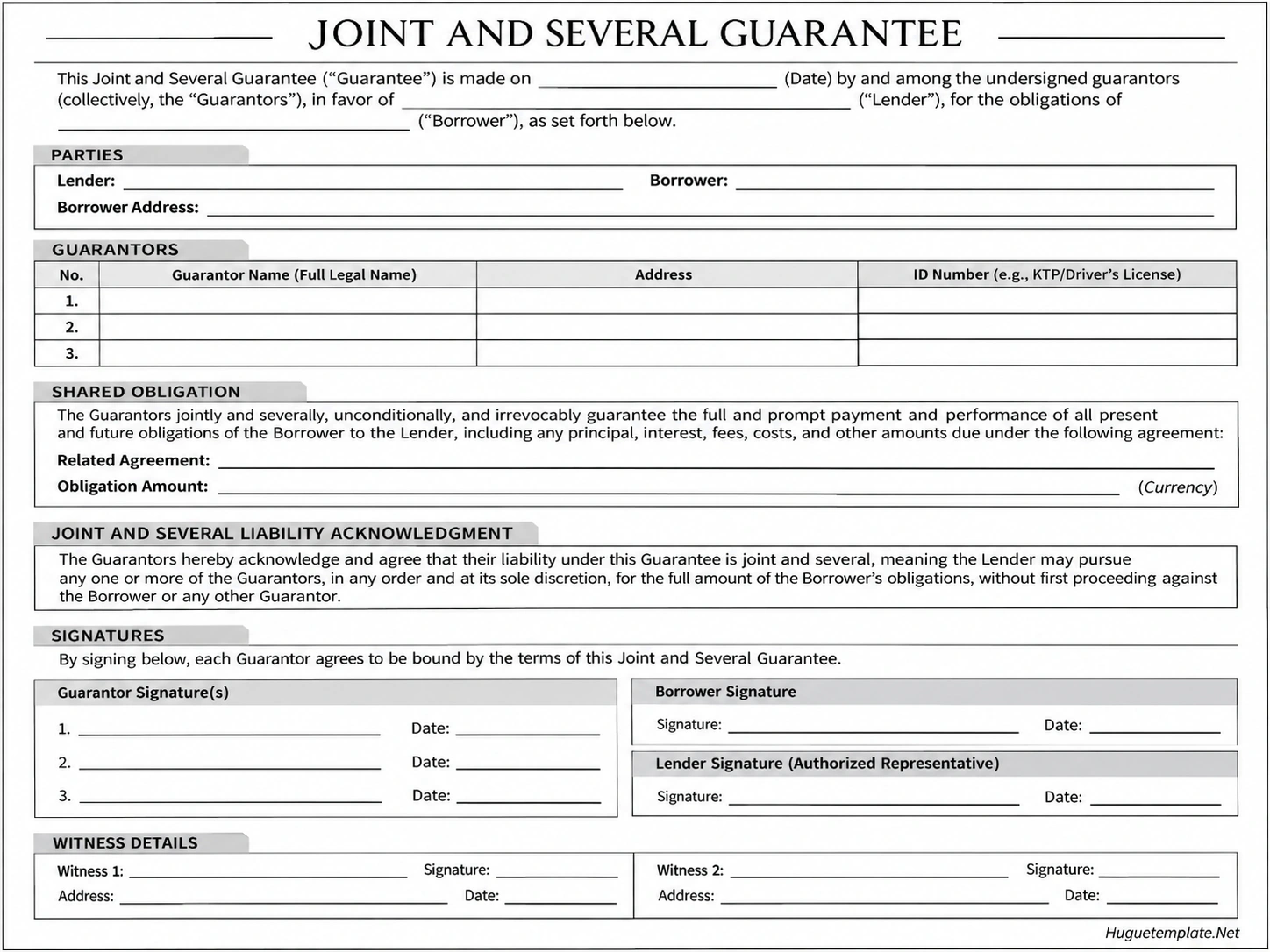
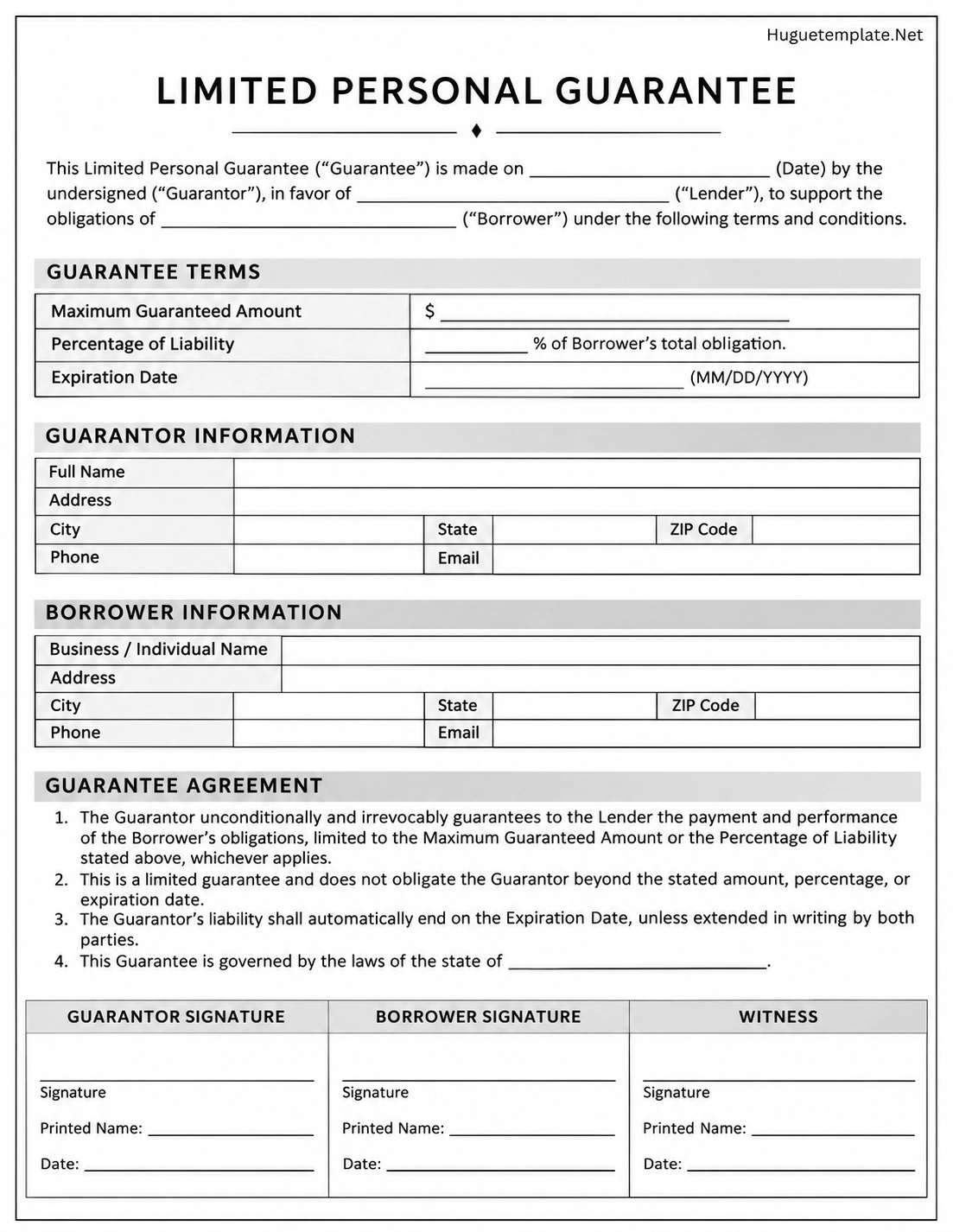
The template includes sections for the guarantor, borrower, lender, underlying obligation, guarantee conditions, and signatures. These fields provide a useful foundation for recording the essential details of a personal guarantee agreement.
However, a printable template should not automatically be treated as a complete or legally sufficient contract. The actual wording must reflect the transaction, the parties’ intentions, and applicable legal requirements.
How to Fill Out a Personal Guarantee Form
Completing a personal guarantee agreement requires attention to detail. Incorrect information or unclear terms may create confusion when the document is later reviewed or enforced.
Step 1: Identify All Parties
Enter the full legal names and relevant contact information of the guarantor, borrower, and creditor. If the borrower is a company, use its registered legal name rather than an informal business name.
Step 2: Describe the Underlying Obligation
Clearly identify the financial obligation covered by the guarantee. Include the relevant loan number, lease agreement, credit arrangement, or reference document whenever applicable.
Step 3: Define the Guarantee Amount
State whether the guarantee is limited or unlimited. For a limited guarantee, specify the maximum amount or percentage of liability. Also clarify whether interest, legal fees, and collection expenses are included in the limit.
Step 4: Explain Default Conditions
Describe the circumstances that allow the creditor to make a claim against the guarantor. These may include missed payments, failure to perform contractual obligations, or other clearly defined default events.
Step 5: Review the Duration and Termination Terms
Specify when the guarantee begins and whether it continues until the underlying obligation is fully satisfied. If the guarantee can be terminated or revoked, explain the applicable procedure and any continuing liability for existing obligations.
Step 6: Review and Sign the Agreement
All relevant parties should carefully review the final document before signing. Include the required signatures, printed names, dates, and witness or notarization details when required by applicable law or the transaction.
Important Risks of Signing a Personal Guarantee
Signing a personal guarantee can create significant financial consequences. A guarantor should understand the potential risks before accepting responsibility for another party’s debt.
Personal Asset Exposure
If the borrower defaults, the guarantor may become personally responsible for the covered debt. Depending on the agreement, applicable law, and collection procedures, personal savings, investments, vehicles, or real estate may be exposed to enforcement actions.
Credit History Impact
Failure to satisfy a guaranteed obligation may affect the guarantor’s credit profile. The precise reporting and credit consequences depend on the creditor, the type of obligation, and applicable credit reporting rules.
Legal and Collection Expenses
Some guarantee agreements allow creditors to recover reasonable collection expenses, attorney fees, or other enforcement costs where legally permitted. These additional amounts may increase the guarantor’s financial responsibility.
Bankruptcy Risk
A substantial unpaid guarantee obligation may contribute to serious financial difficulties. In certain circumstances, a guarantor may face personal insolvency or bankruptcy proceedings if they cannot satisfy their debts.
Tips Before Signing a Personal Guarantee Agreement
Before accepting personal responsibility for another party’s financial obligations, take time to review the agreement and evaluate your financial exposure.
- Read every clause carefully: Never sign a document without understanding the obligations and conditions.
- Negotiate a liability limit: Consider requesting a maximum guaranteed amount rather than accepting unlimited liability.
- Check the duration: Determine whether the guarantee covers one transaction or continues to cover future obligations.
- Understand default provisions: Review when the creditor can demand payment and whether notice or a cure period is required.
- Review additional expenses: Check whether interest, penalties, collection costs, and attorney fees are included.
- Request relevant financial information: Evaluate the borrower’s ability to repay the obligation.
- Seek independent legal advice: Have a qualified attorney review the agreement before signing.
Remember that a personal guarantee is a serious financial commitment. Do not rely solely on verbal assurances from the borrower or creditor when the written agreement contains different terms.
Personal Guarantee Form vs. Co-Signer Agreement
A personal guarantee form and a co-signer agreement both provide additional financial assurance to a creditor. However, their legal structures and the responsibilities they create may differ.
A personal guarantor typically promises to answer for another party’s obligations if the primary borrower defaults. A co-signer, on the other hand, may become directly responsible as a borrower under the underlying credit agreement.
The distinction depends on the actual contract language and applicable law. Therefore, individuals should review the legal responsibilities established by the document rather than relying only on its title.
Frequently Asked Questions About Personal Guarantee Forms
1. What is the purpose of a personal guarantee form?
A personal guarantee form documents an individual’s promise to repay or fulfill another party’s covered financial obligation if the primary borrower defaults. It provides additional financial protection for lenders, landlords, and creditors.
2. Is a personal guarantee form legally binding?
A properly executed personal guarantee may be legally binding. Its enforceability depends on factors such as contract formation, the wording of the agreement, applicable laws, and any required formalities.
3. Can I use a personal guarantee form for a business loan?
Yes. Personal guarantees are commonly used in small business loans, startup financing, and commercial credit arrangements. A business owner may sign the agreement to provide additional security for the lender.
4. What is the difference between a limited and unlimited personal guarantee?
A limited personal guarantee restricts the guarantor’s responsibility to a specified amount, percentage, or defined scope. An unlimited personal guarantee generally covers the full obligations described in the agreement, including additional costs where applicable.
5. Can a personal guarantee affect my personal assets?
Yes. If the borrower defaults and the guarantee is enforceable, the creditor may pursue lawful collection remedies against the guarantor. Depending on applicable exemptions and legal procedures, certain personal assets may be at risk.
6. Can I cancel a personal guarantee?
Cancellation depends on the agreement’s termination provisions and applicable law. Some guarantees may be irrevocable or continue covering existing obligations even after notice of termination. Always review the contract before assuming that cancellation is possible.
7. Does a personal guarantee need to be notarized?
Not every personal guarantee requires notarization. Requirements vary depending on the jurisdiction, the type of transaction, and whether related documents involve secured property or other formalities. Check local legal requirements before signing.
8. Can multiple people sign a personal guarantee form?
Yes. Multiple individuals can act as guarantors under the same agreement. However, the document should explain whether their responsibilities are separate, proportional, joint, or joint and several.
9. What happens if a guarantor refuses to pay?
If a guarantor refuses to fulfill an enforceable obligation, the creditor may pursue legal remedies to recover the covered amount. The available options depend on the agreement and applicable collection laws.
10. Can I download and customize a personal guarantee template?
Yes. A printable personal guarantee template can be used as a starting point for organizing the parties, financial obligations, guarantee terms, and signature details. However, it should be reviewed and customized to meet the specific legal requirements of the transaction.
Conclusion
A personal guarantee form is an important document that establishes an individual’s responsibility for another party’s financial obligations. It is widely used in business financing, commercial leasing, equipment rentals, and supplier credit arrangements.
Before signing or preparing a personal guarantee agreement, make sure the parties, covered obligations, liability limits, default conditions, and termination provisions are clearly defined. Understanding these details can help prevent misunderstandings and reduce unnecessary financial risks.
Using a printable personal guarantee form template can make the documentation process easier. However, always adapt the document to the specific transaction and seek qualified legal advice to ensure that the final agreement meets applicable legal requirements.
Download: Personal Guarantee Form Template Word
