A promissory agreement is a written document in which a borrower promises to repay a specific amount of money to a lender according to clearly defined terms. It provides a written record of the loan and can explain important details such as the principal amount, interest rate, payment schedule, due dates, late payment terms, and signatures.
By putting the agreement in writing, both parties have a clearer understanding of their responsibilities. A well-organized promissory agreement can help prevent misunderstandings and provide a useful record of the financial arrangement.
Whether the loan is between individuals, family members, business partners, or other parties, the agreement should clearly describe the obligations being accepted by the borrower and lender. Because requirements and enforceability can vary by jurisdiction, an appropriate legal professional should review the document when necessary.
What Is a Promissory Agreement?
A promissory agreement is a written promise by one party to repay money owed to another party. The person receiving the loan is generally referred to as the borrower or maker, while the person providing the funds is generally referred to as the lender or payee.
The document establishes the terms under which repayment will occur. Depending on the arrangement, it may cover a single repayment, a series of installments, interest, late fees, collateral, prepayment, and other conditions.
A promissory agreement may also be referred to as a promissory note in some contexts. However, terminology and legal requirements can vary depending on the jurisdiction and type of transaction.
Why Use a Promissory Agreement?
A written loan agreement gives the borrower and lender a shared record of what they agreed to. Instead of relying on verbal promises or informal messages, important financial terms can be documented in one place.
A promissory agreement can help clarify:
- The amount borrowed
- The parties involved in the loan
- The applicable interest rate
- The repayment schedule
- The amount of each payment
- The final payment due date
- Late payment provisions
- Prepayment terms
- Additional conditions
- The signatures of the parties
Clear documentation can reduce uncertainty and make it easier for both parties to understand what is expected throughout the repayment period.
Key Elements of a Promissory Agreement
A useful promissory agreement should contain enough information to clearly describe the loan and repayment obligations. The exact provisions needed may depend on the type of loan and applicable law.
1. Lender and Borrower Information
The agreement should identify the parties involved. This typically includes the legal names of the lender and borrower and may include their addresses or other identifying information.
Accurate information is important because the agreement creates obligations between the parties identified in the document.
2. Loan Amount
The principal amount should be stated clearly. It is useful to identify the amount both numerically and in words when appropriate to reduce the possibility of confusion.
The agreement should make it clear how much money the borrower is obligated to repay, before considering applicable interest or other charges.
3. Interest Rate
If interest applies, the promissory agreement should state the applicable interest rate and explain how interest is calculated when necessary.
Interest provisions should comply with applicable laws and any restrictions that may apply to the particular type of loan. When the legal requirements are unclear, professional advice can help ensure the terms are appropriate.
4. Repayment Schedule
The repayment section explains how and when the borrower will repay the loan. It may specify the first payment date, payment frequency, payment amount, number of payments, and final due date.
Common payment frequencies include:
- Weekly payments
- Biweekly payments
- Monthly payments
- Quarterly payments
- A single lump-sum payment
A clear repayment schedule makes it easier for both parties to track the loan and identify upcoming obligations.
5. Payment Method
The agreement may also specify how payments should be made. For example, the parties may agree to use electronic transfers, checks, or another mutually accepted payment method.
Including payment instructions can reduce uncertainty and make the repayment process more consistent.
6. Late Payment Terms
A promissory agreement may explain what happens if a scheduled payment is not made on time. Depending on the agreement and applicable law, this could include a grace period, late fee, additional interest, or other consequences.
Any late payment provision should be stated clearly and should comply with applicable legal requirements.
7. Prepayment Terms
The agreement can explain whether the borrower may repay some or all of the outstanding balance before the scheduled due date.
If a prepayment penalty or other condition applies, it should be clearly disclosed in the agreement so both parties understand the consequences of early repayment.
8. Additional Terms
Depending on the loan, additional provisions may be necessary. These could address collateral, default, notices, dispute resolution, applicable law, amendments, or other transaction-specific requirements.
The terms should be appropriate for the particular loan rather than copied from an unrelated agreement.
9. Signatures and Dates
The parties should sign and date the agreement according to the applicable requirements. Signatures provide evidence that the parties accepted the terms stated in the document.
Depending on the circumstances and jurisdiction, additional formalities such as notarization or witnessing may be relevant.
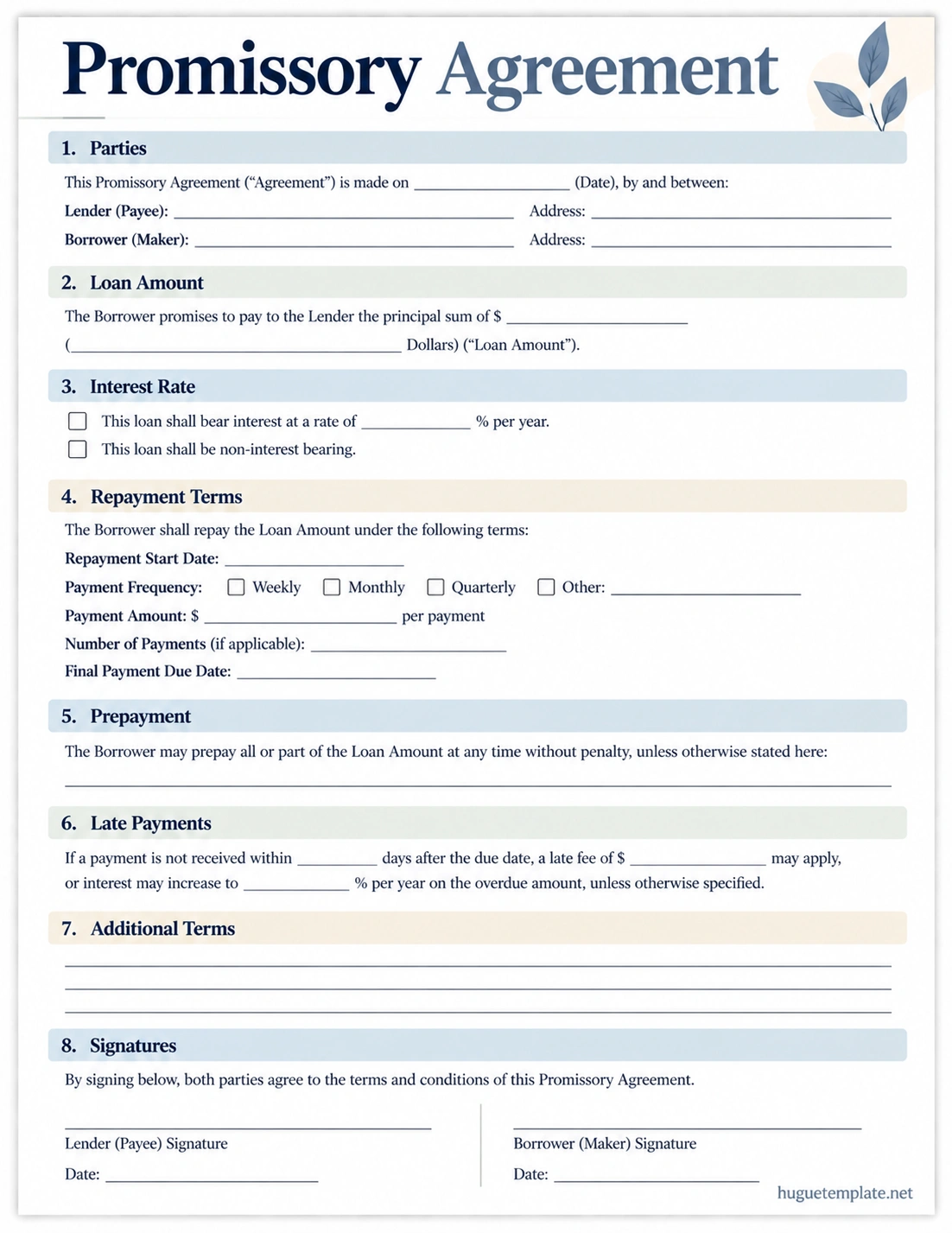
How a Promissory Agreement Works
A promissory agreement generally follows a straightforward process. The lender and borrower first agree on the financial terms, then document those terms in writing.
Step 1: Agree on the Loan Terms
The parties should discuss the principal amount, interest, repayment schedule, payment method, and other important conditions before preparing the final document.
Step 2: Put the Terms in Writing
The agreed terms should be entered into a written promissory agreement. Avoid leaving important financial details based only on verbal discussions.
Step 3: Review the Agreement
Both parties should carefully review the document before signing. Check names, amounts, dates, interest rates, payment schedules, and other conditions for accuracy.
Step 4: Sign the Agreement
The lender and borrower should execute the agreement using the required signatures and formalities. Each party should retain a complete copy of the signed document.
Step 5: Follow the Repayment Schedule
The borrower makes payments according to the agreed schedule, while the lender can maintain appropriate records of payments received and the remaining balance.
Promissory Agreement vs. Loan Agreement
A promissory agreement and a loan agreement can both document borrowing arrangements, but they may serve different purposes depending on how they are drafted and used.
A promissory agreement generally focuses on the borrower’s written promise to repay a specified amount under stated terms. A more comprehensive loan agreement may contain additional provisions governing the overall lending relationship, including representations, conditions, collateral, default provisions, and other obligations.
The terminology and legal effect of these documents can vary by jurisdiction. The appropriate document depends on the transaction and the legal requirements that apply.
Promissory Agreement vs. Promissory Note
The terms promissory agreement and promissory note are sometimes used interchangeably in everyday discussions, but they do not necessarily refer to identical documents in every legal context.
A promissory note generally documents an unconditional promise to pay a specified amount according to stated terms. A promissory agreement may be drafted more broadly and can contain additional provisions concerning the loan arrangement.
When preparing a document for an actual transaction, it is important to use terminology and provisions appropriate to the applicable law and circumstances.
Tips for Creating a Clear Promissory Agreement
A good loan document should be easy to understand and specific enough to reduce uncertainty. The following practices can help improve clarity.
- Use complete legal names: Identify the lender and borrower accurately.
- State the principal clearly: Make the loan amount easy to identify.
- Define interest terms: State whether interest applies and how it is calculated.
- Set specific payment dates: Avoid vague repayment deadlines.
- Explain late payments: Clearly state applicable consequences and any grace period.
- Document prepayment terms: Explain whether early repayment is permitted and whether any conditions apply.
- Keep records: Maintain copies of the signed agreement and payment records.
- Review legal requirements: Make sure the terms comply with applicable laws.
- Consider professional review: Seek legal advice when the transaction is substantial or complex.
Common Mistakes to Avoid
Leaving the Loan Amount Unclear
The principal amount should be stated precisely. An unclear loan amount can create unnecessary disputes about how much the borrower is required to repay.
Using Vague Repayment Terms
A statement such as “the borrower will repay the loan regularly” may not provide enough detail. Specific payment dates, amounts, or a defined repayment method can make the agreement clearer.
Forgetting the Interest Terms
If interest applies, the agreement should clearly state the applicable rate and relevant calculation method. If the loan is interest-free, that should also be clearly documented.
Ignoring Late Payment Provisions
Payment delays can create disagreements if the agreement does not explain what happens after a missed payment. Clearly defined terms can help both parties understand their rights and obligations.
Relying Only on a Template
A generic promissory agreement template can help organize information, but it may not address the requirements of every loan or jurisdiction. A template should be reviewed and adapted to the specific transaction.
When Should You Use a Promissory Agreement?
A written repayment agreement may be useful whenever one party provides money to another with an expectation of repayment. Potential situations include personal loans, business loans, private lending arrangements, or certain transactions between individuals.
The document should be appropriate for the specific relationship and purpose of the loan. More complex arrangements may require a comprehensive loan agreement or additional legal documents.
Frequently Asked Questions
What is a promissory agreement?
A promissory agreement is a written document in which a borrower promises to repay money to a lender according to specified terms. It can identify the loan amount, interest rate, repayment schedule, due dates, and other conditions.
Is a promissory agreement legally binding?
A properly executed agreement may create legally enforceable obligations, but enforceability depends on applicable law, the wording of the document, required formalities, and the circumstances of the transaction. Legal requirements can vary by jurisdiction.
What should a promissory agreement include?
A promissory agreement commonly includes lender and borrower information, the principal amount, interest rate, repayment schedule, payment terms, late payment provisions, prepayment terms, additional conditions, and signatures.
Does a promissory agreement need to be notarized?
Notarization requirements vary depending on the jurisdiction and circumstances. Some agreements may not require notarization, while additional formalities may be advisable or required in certain situations.
Can a promissory agreement be used for a personal loan?
Yes, a written repayment agreement may be used to document certain personal loans. The agreement should clearly state the amount borrowed and the terms agreed upon by the parties.
Can a promissory agreement include interest?
Yes, a promissory agreement can specify an interest rate when interest applies. The rate and calculation method should be clearly stated and should comply with applicable legal requirements.
Can a borrower repay a promissory agreement early?
Early repayment depends on the terms of the agreement. The document should explain whether prepayment is allowed and whether any penalty or other condition applies.
What happens if a borrower does not repay the loan?
The consequences of nonpayment depend on the terms of the agreement and applicable law. A default provision may describe available remedies, but the actual rights of the parties depend on the specific circumstances and legal requirements.
Conclusion
A promissory agreement provides a written framework for a borrowing arrangement by documenting the borrower’s promise to repay money under clearly defined terms. Important provisions can include the loan amount, interest rate, repayment schedule, payment dates, late payment terms, prepayment provisions, and signatures.
Clear and specific terms can help both the lender and borrower understand their responsibilities and reduce the possibility of misunderstandings. A well-organized promissory agreement also provides a useful written record of the financial arrangement.
Because loan agreements can create significant legal obligations, a generic template should be adapted to the specific transaction and applicable law. For substantial, complex, or disputed transactions, consider having the document reviewed by a qualified legal professional before it is signed.
Download: Promissory Agreement Template
