Leaving a job is an important career decision, and the way you communicate your departure can influence your professional reputation. A professional resignation letter helps you formally notify your employer, confirm your final working day, and express appreciation for the opportunities you have received. It also creates a written record of your decision and helps maintain a positive relationship with your employer.
Whether you are accepting a new position, pursuing a different career path, or leaving for personal reasons, writing a clear resignation letter is an important part of the process. The letter does not need to be complicated or lengthy. It should communicate your decision respectfully, provide the appropriate notice, and offer reasonable assistance with the transition.
In this guide, you will learn how to write a professional resignation letter, what information to include, and how to use practical examples to create a polished letter that suits your situation.
What Is a Professional Resignation Letter?
A professional resignation letter is a formal written document that informs an employer of an employee’s decision to leave their position. It is usually addressed to a direct supervisor, manager, or human resources representative.
Unlike an informal conversation or brief email, a formal resignation letter provides documented confirmation of your departure. It clearly states your intention to resign, identifies your position, and specifies your expected last working day.
A well-written resignation letter also demonstrates professionalism and consideration. Even when you are leaving because of a difficult workplace experience, maintaining a respectful tone can help protect your professional relationships and future references.
What to Include in a Professional Resignation Letter
A good resignation letter should be straightforward and easy to understand. Although the exact format may vary depending on your workplace, most professional resignation letters include the following elements.
1. Your Contact Information
Start with your name and relevant contact details. If you are writing a traditional business letter, include your mailing address, email address, and phone number at the top.
2. The Date
Include the date you submit the letter. This creates a clear record of when you formally notified your employer of your resignation.
3. Employer or Recipient Information
Address the letter to your direct supervisor, department manager, or HR representative. Include their name, job title, and company name when appropriate.
4. A Clear Statement of Resignation
Open the main message by stating that you are formally resigning from your current position. Avoid vague wording that could make your intention unclear.
5. Your Final Working Day
Clearly specify your intended last working day. Check your employment agreement and company policies to understand the required notice period before choosing a date.
6. A Brief Expression of Appreciation
Consider thanking your employer for the opportunities, experience, or professional development you received. Your appreciation should sound sincere and appropriate to your circumstances.
7. An Offer to Assist With the Transition
Where practical, offer to document ongoing tasks, organize important files, transfer responsibilities, or help train another team member. This demonstrates consideration for your colleagues and employer.
8. A Professional Closing
Finish with a courteous closing such as “Sincerely” or “Best regards,” followed by your full name. If you are submitting a printed letter, leave space for your signature.
Professional Resignation Letter Example
The following example demonstrates how to communicate your resignation in a respectful and professional manner. You can customize the names, job title, company details, and final working day to match your circumstances.
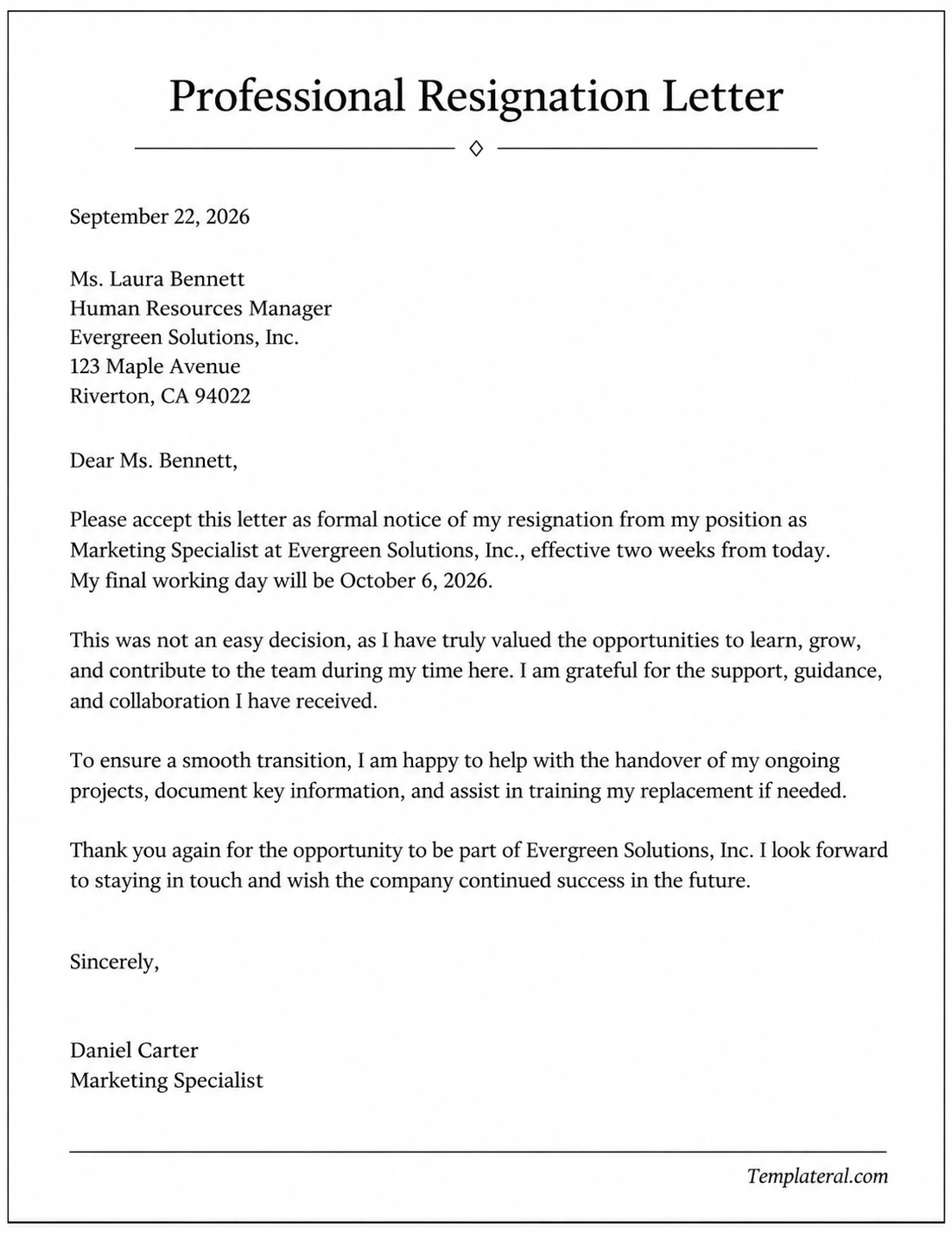
Sample Letter
Daniel Carter
123 Maple Avenue
Riverton, CA 94022
daniel.carter@email.comSeptember 22, 2026
Ms. Laura Bennett
Human Resources Manager
Evergreen Solutions, Inc.
123 Maple Avenue
Riverton, CA 94022Dear Ms. Bennett,
Please accept this letter as formal notice of my resignation from my position as Marketing Specialist at Evergreen Solutions, Inc. My final working day will be October 6, 2026.
This was not an easy decision, as I have truly valued the opportunities to learn, grow, and contribute to the team during my time here. I am grateful for the support, guidance, and collaboration I have received.
To ensure a smooth transition, I am happy to help with the handover of my ongoing projects, document key information, and assist in training my replacement if needed.
Thank you again for the opportunity to be part of Evergreen Solutions, Inc. I look forward to staying in touch and wish the company continued success in the future.
Sincerely,
Daniel Carter
Marketing Specialist
How to Write a Professional Resignation Letter Step by Step
Writing a resignation letter becomes easier when you follow a simple structure. Use these steps to create a letter that communicates your decision clearly and respectfully.
Step 1: Review Your Employment Agreement
Before writing your letter, review your employment contract, employee handbook, or company resignation policy. These documents may explain how much notice you are expected to provide and whether there are specific submission requirements.
Do not automatically assume that two weeks’ notice applies to every position. Your contractual obligations and local employment regulations may differ.
Step 2: Choose the Right Tone
Keep your language professional, polite, and direct. You do not need to explain every reason behind your decision. A brief statement is usually sufficient.
If you are leaving because of a negative workplace experience, avoid using the resignation letter to express frustration or criticize individual colleagues. Save detailed feedback for an appropriate exit interview if necessary.
Step 3: State Your Resignation Clearly
Make your intention clear in the opening paragraph. For example, you can write, “Please accept this letter as formal notice of my resignation from my position as [Job Title].”
This straightforward sentence helps prevent misunderstandings about the purpose of your letter.
Step 4: Confirm Your Final Working Day
Include the exact date you expect to finish working. Make sure the date is consistent with your required notice period and any arrangements agreed upon with your employer.
Step 5: Offer Transition Assistance
A thoughtful resignation letter acknowledges that your departure may affect the team. Offer reasonable support with outstanding assignments, documentation, or the transfer of responsibilities.
Step 6: Proofread Before Sending
Check the letter for spelling mistakes, incorrect dates, missing information, and unclear statements. Make sure the recipient’s name and job title are correct. A carefully reviewed document creates a better professional impression.
Professional Resignation Letter for Different Situations
Not every resignation requires the same wording. Depending on your circumstances, you may need a slightly different approach.
Resignation Letter With Two Weeks’ Notice
This is a common approach when an employee intends to provide approximately two weeks of notice. State the submission date and final working day clearly. Confirm that this notice period meets your employment requirements.
Resignation Letter for a New Job Opportunity
If you are leaving to accept another position, you can mention that you have decided to pursue a new professional opportunity. However, you are not required to disclose your new employer, salary, or other private details.
Resignation Letter for Personal Reasons
When leaving for family responsibilities, personal circumstances, or other private matters, keep your explanation brief. You can simply state that you are resigning for personal reasons without sharing sensitive information.
Short Professional Resignation Letter
If your workplace prefers concise communication, a short resignation letter may be sufficient. Include your position, resignation statement, final working day, and a brief thank-you message. Keep the essential information even when using a shorter format.
Immediate Resignation Letter
An immediate resignation letter communicates that you intend to leave without completing a standard notice period. Before using this approach, review your employment agreement and applicable local requirements. If possible, discuss the circumstances with your employer and confirm the agreed departure date in writing.
Tips for Maintaining a Positive Professional Relationship
Your resignation is not only about leaving a position. It is also an opportunity to conclude your employment respectfully. Consider these practical tips before submitting your letter.
- Speak with your manager first: When appropriate, arrange a private conversation before submitting your formal resignation.
- Provide reasonable notice: Follow your employment agreement and applicable requirements whenever possible.
- Keep the message positive: Focus on your decision and appreciation rather than workplace complaints.
- Complete outstanding responsibilities: Make a reasonable effort to finish important assignments before your departure.
- Organize your handover: Prepare relevant documents, project updates, and essential information for your colleagues.
- Return company property: Follow the company’s instructions for returning equipment, identification cards, keys, and other materials.
- Save appropriate employment records: Keep personal copies of relevant documents that you are permitted to retain, while respecting company confidentiality policies.
These small steps can make your departure smoother and help preserve professional connections that may be valuable throughout your career.
Common Mistakes to Avoid When Writing a Resignation Letter
Even a simple resignation letter can create unnecessary problems if important details are missing or the tone is inappropriate. Avoid the following mistakes.
- Failing to include your final working day: An unclear departure date can create confusion for managers and HR staff.
- Writing an overly emotional message: Keep personal frustrations and accusations out of the formal notice.
- Providing unnecessary personal details: You can communicate your decision without explaining private circumstances.
- Using an informal tone: Avoid slang, jokes, or language that may appear careless.
- Ignoring notice requirements: Check your contract and company policy before submitting the letter.
- Forgetting to proofread: Incorrect names, dates, or job titles can make your document look unprofessional.
- Making promises you cannot fulfill: Only offer transition assistance that you can reasonably provide before your departure.
Resignation Letter Format and Presentation Tips
A professional resignation letter should have a clean, readable layout. Traditional business-letter formatting is suitable for most formal workplace situations.
For a polished appearance, consider these formatting recommendations:
- Use a simple, professional font such as Arial, Calibri, or Times New Roman.
- Choose a readable font size, typically between 10 and 12 points.
- Use standard margins and consistent paragraph spacing.
- Keep the letter to approximately one page whenever possible.
- Use a clear subject line when submitting your resignation by email.
- Save a printed or digital copy for your personal employment records, where permitted.
If you are sending your resignation by email, use a descriptive subject such as “Formal Resignation – [Your Name].” Keep the email body professional and attach a signed letter if your employer requires one.
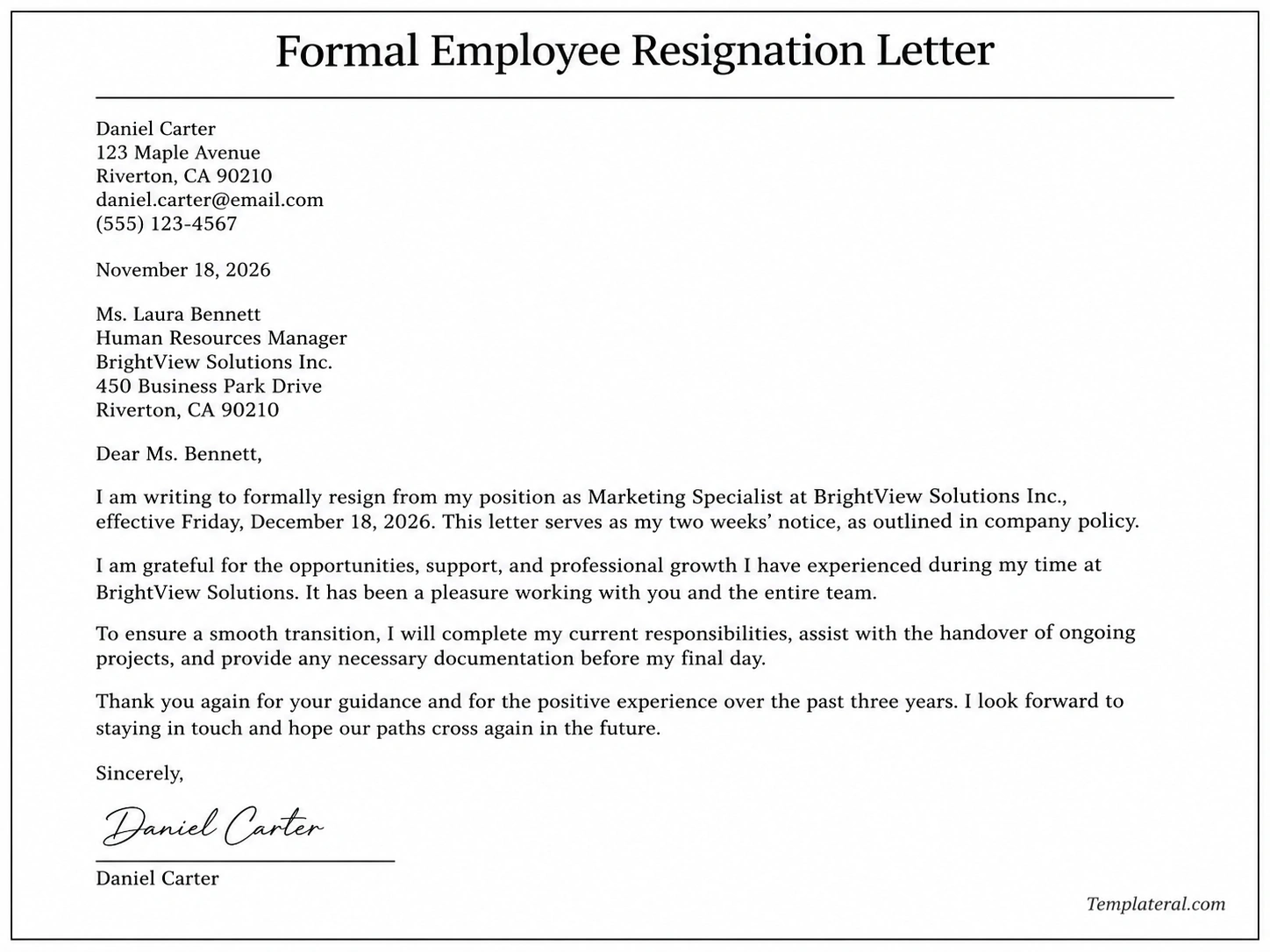
Planning a Smooth Transition Before Your Last Day
Submitting your resignation is only one part of leaving a job professionally. Preparing for your departure can help your team continue working with minimal disruption.
Consider creating a simple transition checklist that includes:
- A list of current projects and their completion status.
- Important deadlines and upcoming responsibilities.
- Relevant work instructions and documentation.
- Contact information for essential project stakeholders, where sharing is authorized.
- Outstanding tasks that need to be reassigned.
- Company equipment and access credentials that must be returned or transferred according to policy.
A written handover plan makes it easier for your manager and colleagues to understand what needs attention after you leave. It also demonstrates that you take your responsibilities seriously until your final working day.
Frequently Asked Questions About Professional Resignation Letters
1. How do you write a professional resignation letter?
Start by addressing your manager or HR representative. Clearly state that you are resigning, identify your current position, and provide your intended final working day. Add a brief expression of appreciation, offer reasonable transition assistance, and finish with a professional closing.
2. How long should a professional resignation letter be?
Most professional resignation letters should fit on one page. A few well-organized paragraphs are usually enough to communicate your decision, notice period, appreciation, and transition arrangements.
3. Do I need to explain why I am resigning?
No. In most situations, you do not need to provide a detailed explanation. You can simply state that you have decided to resign. If you wish, you may briefly mention a new opportunity or personal reasons without sharing private information.
4. Is two weeks’ notice required when resigning?
Not necessarily. The required notice period depends on your employment agreement, company policies, and applicable employment laws. Review the relevant requirements before selecting your final working day.
5. Can I submit my resignation letter by email?
Yes, many employers accept resignation notices by email. However, follow your company’s preferred submission procedure. Use a professional subject line, keep the message clear, and attach a formal letter if requested.
6. Should I thank my employer in a resignation letter?
Including a brief thank-you message is generally recommended when appropriate. It helps maintain a respectful tone and acknowledges the professional experience or opportunities you received during your employment.
7. Can I resign without giving notice?
Whether you can leave without notice depends on your employment terms and applicable laws. If you need to leave immediately, communicate your circumstances clearly and discuss the arrangements with your employer. Confirm any agreed departure terms in writing.
8. Should I sign my resignation letter?
A printed resignation letter should generally include your handwritten signature. For an email resignation, typing your full name is often sufficient, unless your employer requests a signed attachment or another formal verification method.
Conclusion
A professional resignation letter is an important document that formally communicates your decision to leave a job while helping maintain a positive relationship with your employer. By including a clear resignation statement, your final working day, a brief expression of appreciation, and an offer to assist with the transition, you can make the process more organized and respectful.
Before submitting your letter, review your employment requirements, check all important details, and choose wording that reflects your professional standards. Whether you need a short resignation notice, a traditional business letter, or a resignation letter with a transition plan, the right format can help you leave your position with confidence and professionalism.
Use the examples and writing tips in this guide to prepare a professional resignation letter that fits your situation and supports a smooth transition to the next stage of your career.
Download: Professional Resignation Letter Template Word
