A proof of funds letter is a formal document used to demonstrate that a buyer has sufficient funds available to complete a purchase. It is commonly requested during real estate transactions, business acquisitions, and other high-value purchases where sellers or lenders want evidence of financial readiness.
When a buyer makes an offer on a property, the seller may want reassurance that the buyer can cover the purchase price or required closing costs. A proof of funds letter provides written confirmation of available financial resources, usually based on information verified by a bank or another authorized financial institution.
Understanding how a proof of funds letter works can help buyers prepare for a transaction and respond to documentation requests more efficiently. A proof of funds letter template also provides a convenient starting point for organizing the information a bank, financial institution, or other authorized provider may need to include.
What Is a Proof of Funds Letter?
A proof of funds letter is a document that confirms a person or business has access to a stated amount of money for a particular transaction. It is often issued by a bank, credit union, or other financial institution after reviewing the relevant account information.
The letter generally identifies the account holder, states the available balance as of a specified date, and confirms whether the funds are available for the intended purchase. The exact details depend on the institution, the transaction, and the recipient’s requirements.
Proof of funds may be requested when buying a house, purchasing commercial property, acquiring a business, or making another substantial purchase. It can help a seller assess whether a buyer appears financially prepared to proceed.
A proof of funds letter is not necessarily a loan approval, a mortgage preapproval, or a guarantee that a transaction will close. It demonstrates available funds based on the information verified by the issuing party.
Why Is a Proof of Funds Letter Important?
A proof of funds letter helps reduce uncertainty during a transaction by providing evidence that the buyer has financial resources available. Its value depends on the accuracy, recency, and credibility of the information presented.
It Demonstrates Financial Readiness
Buyers can use the letter to show that they have sufficient funds for a proposed purchase. This may strengthen their position when a seller needs reassurance that the transaction can move forward.
It Supports Real Estate Offers
In real estate transactions, sellers and listing agents may request proof of funds to evaluate offers, particularly when a buyer proposes an all-cash purchase. The document can help demonstrate that the buyer has the resources needed to complete the transaction.
It Helps Sellers Assess Offers
When sellers receive several offers, reliable financial documentation can help them understand each buyer’s readiness. However, proof of funds is only one consideration, and it does not automatically make an offer preferable to others.
It Can Support High-Value Purchases
Businesses, investment sellers, and other parties involved in substantial transactions may request proof of funds before entering negotiations or proceeding to the next stage. The letter can provide a convenient summary of available financial resources.
It Improves Transaction Preparation
Preparing proof of funds early can help buyers identify documentation requirements before making an offer. This reduces last-minute delays and allows the relevant financial institution to clarify what it can verify.
What Information Should a Proof of Funds Letter Include?
A professional proof of funds letter should present the necessary information clearly without exposing more sensitive financial data than the recipient requires.
Issuing Institution’s Information
The letter should identify the bank or financial institution providing the confirmation. It may include the institution’s address, contact details, and authorized representative’s information.
Account Holder’s Name
The document should identify the person or business whose funds are being verified. The name should match the relevant account records and the transaction documentation where applicable.
Available Balance
The letter should state the amount of funds the institution is able to confirm as available. It should also identify the date of verification because account balances can change over time.
Currency and Account Information
Specify the currency of the stated balance. The institution may identify the type of account or provide limited account details, depending on its policies and the recipient’s requirements.
Full account numbers and other sensitive identifiers should not be included unless they are genuinely necessary and disclosure is handled securely.
Purpose of the Letter
When appropriate, identify the intended transaction, such as a property purchase or business acquisition. This helps the recipient understand why the confirmation was prepared.
Authorized Signature and Contact Details
A formal bank-issued letter may include the name and title of an authorized representative, a signature, and contact details for verification. The exact format depends on the issuing institution’s procedures.
Proof of Funds Letter Template
A proof of funds letter template helps organize the information commonly found in a financial verification letter. The following sample illustrates a typical format, but it is not a substitute for confirmation issued by a bank or other authorized financial institution.
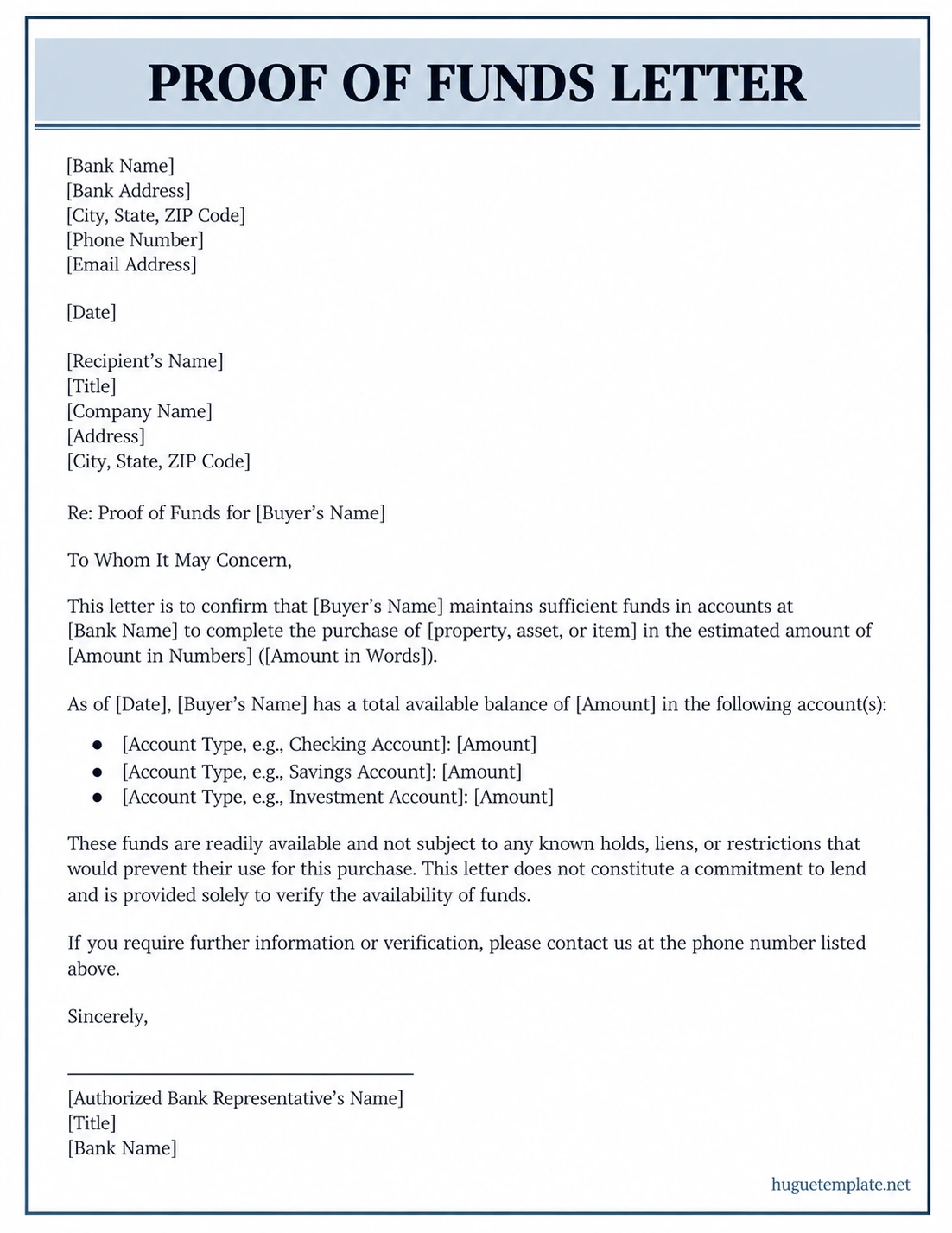
[Bank or Financial Institution Name]
[Institution Address]
[City, State, ZIP Code]
[Phone Number]
[Email Address]
[Date]
[Recipient’s Name]
[Recipient’s Title or Company]
[Recipient’s Address]
Subject: Proof of Funds for [Buyer’s Name]
To Whom It May Concern,
This letter confirms that, based on our records as of [Verification Date], [Buyer’s Full Name] maintains funds with [Financial Institution Name] in the amount of [Amount and Currency].
The verified available balance is intended to support the proposed purchase of [Property, Asset, or Item], subject to the applicable account terms and any restrictions or conditions disclosed by the institution.
This letter is provided solely to confirm the financial information stated above. It does not constitute a commitment to lend, a guarantee of payment, or an assurance that the funds will remain available after the verification date.
For further information or verification, please contact us using the official contact details provided above, subject to our verification and privacy procedures.
Sincerely,
[Authorized Representative’s Name]
[Title]
[Financial Institution Name]
Important: This sample is for drafting and reference purposes only. A buyer should not present a self-created letter as an official bank confirmation. Request an authentic document from the financial institution or other provider authorized to verify the funds.
How to Obtain a Proof of Funds Letter
The process of obtaining a proof of funds letter is usually straightforward, although requirements vary by financial institution and transaction type.
Identify the Recipient’s Requirements
Ask the seller, real estate agent, attorney, or transaction coordinator what documentation is acceptable. Confirm the required amount, currency, verification date, and whether the letter must come directly from a financial institution.
Contact Your Financial Institution
Contact your bank through its official website, secure banking portal, customer service number, or local branch. Explain that you need a proof of funds letter for a specific transaction.
Provide the Necessary Information
The institution may ask you to identify the relevant account, confirm your identity, specify the intended purpose, and authorize the release of financial information.
Ask whether the letter can confirm the available balance and whether the institution can send it directly to the recipient.
Review the Letter Carefully
Before submitting the document, check the account holder’s name, verified amount, currency, date, and recipient details. If any information is incorrect or incomplete, request a corrected version from the issuing institution.
Submit It Securely
Send the letter using the recipient’s approved submission method. Because financial documents contain sensitive information, avoid posting them publicly or sending them to unverified email addresses.
Proof of Funds Letter for Real Estate Purchases
Real estate transactions are among the most common situations in which proof of funds may be requested. The document can help a seller understand whether a buyer has sufficient available resources for a cash purchase or a required portion of the transaction.
Cash Home Purchases
For an all-cash home purchase, the seller may request proof that the buyer has enough available funds to cover the agreed purchase price and relevant transaction costs. The required amount and acceptable evidence depend on the seller, transaction arrangements, and local practices.
Earnest Money and Closing Costs
In some transactions, a buyer may need to demonstrate access to funds for an earnest money deposit, closing costs, or other required payments. Confirm exactly what the recipient wants to verify rather than assuming that every proof of funds request has the same purpose.
Mortgage-Financed Purchases
Buyers using a mortgage may still need to demonstrate funds for a down payment, closing costs, reserves, or other requirements. However, a proof of funds letter does not replace mortgage preapproval or the lender’s underwriting process.
Proof of Funds Letter vs. Bank Statement
A proof of funds letter and a bank statement can both provide financial information, but they serve different purposes.
- Proof of funds letter: A concise confirmation of available funds, often issued or verified by a financial institution for a specific transaction.
- Bank statement: A record of account activity and balances over a defined period, which may show deposits, withdrawals, and other transactions.
Some recipients accept a recent bank statement, while others require a formal letter or additional verification. Always confirm the acceptable format before sharing financial documents.
Proof of Funds Letter vs. Preapproval Letter
A proof of funds letter confirms the availability of certain financial resources. A mortgage preapproval letter, by contrast, indicates that a lender has conducted a preliminary assessment of a borrower’s eligibility for a potential loan, subject to conditions.
The two documents are not interchangeable. A cash buyer may use proof of funds to demonstrate available money, while a buyer who needs financing may be asked to provide a preapproval letter and evidence of funds for the down payment and closing costs.
Common Mistakes to Avoid
Preparing the right documentation can prevent confusion and delays during a purchase. Avoid these common proof of funds mistakes.
- Using outdated information: Request a recent confirmation because account balances may change.
- Showing an insufficient amount: Confirm the required funds and currency with the recipient before requesting the letter.
- Confusing assets with available cash: Investments or property holdings may not be immediately accessible without selling or transferring them.
- Submitting an altered document: Never change a bank-issued balance, signature, date, or other financial detail.
- Sharing excessive information: Provide only the personal and account information necessary for verification.
- Assuming the letter guarantees payment: A balance confirmation does not necessarily guarantee that funds will remain available or that a transaction will close.
- Ignoring recipient requirements: Confirm whether the recipient needs a bank letter, statement, direct verification, or another acceptable document.
Tips for Protecting Your Financial Information
Proof of funds documents can contain confidential financial information. Take sensible precautions when requesting, storing, and submitting them.
- Use official channels: Contact your bank through verified contact details.
- Confirm the recipient: Verify the identity and legitimacy of the person requesting the document.
- Limit account details: Do not disclose full account numbers or unrelated transactions unless required and appropriate.
- Use secure delivery: Prefer secure portals or other approved methods for sensitive documents.
- Keep a copy: Retain the submitted document and related correspondence in a secure location.
Frequently Asked Questions About Proof of Funds Letters
What is a proof of funds letter used for?
A proof of funds letter demonstrates that a buyer has a stated amount of available financial resources for a purchase. It is commonly used in real estate transactions, business acquisitions, and other high-value purchases.
Who can issue a proof of funds letter?
A bank, credit union, or another authorized financial institution may issue a proof of funds letter, depending on its policies. The recipient should confirm which issuing sources and document formats are acceptable.
Can I write my own proof of funds letter?
You can prepare a draft or organize the information a provider needs, but you should not present a self-written document as official financial verification. If formal proof is required, obtain authentic confirmation from an authorized institution or provider.
How recent should a proof of funds letter be?
The required date depends on the recipient’s rules and the transaction. Ask whether the recipient requires a letter issued within a particular period and whether the balance must be verified again before closing.
Does a proof of funds letter guarantee that a purchase will close?
No. The letter provides evidence of available funds as of a stated date, subject to its terms. It does not guarantee that the funds will remain available or that every other condition of the transaction will be satisfied.
Can a bank statement be used instead of a proof of funds letter?
Sometimes. Some recipients accept a recent bank statement, while others require a formal letter or direct verification. Confirm the specific requirements before submitting your documents.
Is a proof of funds letter the same as a mortgage preapproval?
No. Proof of funds confirms available financial resources, while mortgage preapproval concerns a lender’s preliminary assessment of potential borrowing eligibility. A buyer may need both documents when purchasing a property with financing.
Does a proof of funds letter show my full account balance?
Not necessarily. The letter may state the amount the institution is able to verify for the intended purpose. Ask the institution whether it can confirm a specific available amount while limiting unnecessary disclosure of sensitive information.
Conclusion
A proof of funds letter is a useful document for demonstrating that a buyer has access to financial resources for a proposed purchase. It can help sellers, real estate professionals, and other transaction participants evaluate financial readiness and determine whether additional verification is needed.
Use a proof of funds letter template as a guide to understanding the information commonly included in the document. Then contact the appropriate financial institution to obtain authentic verification, confirm the recipient’s requirements, and submit the document securely.
By keeping the information accurate, current, and appropriately protected, buyers can prepare for high-value transactions with greater confidence while helping sellers make more informed decisions.
Download: Proof of Funds Letter Template
