A quit-claim deed form is a legal document used to transfer whatever interest a person may have in real property to another person without providing a warranty that the title is clear. Unlike a warranty deed, a quit-claim deed generally does not guarantee that the grantor owns the property free from other claims or title defects.
Because of its limited protection, a quit-claim deed is often used when the parties already know and trust each other. Common situations include transfers between family members, changes in ownership following a divorce, adding or removing someone from a property title, and certain transfers between related parties.
Although a quit-claim deed can be relatively simple, the requirements for preparing, signing, notarizing, and recording the document vary by state and county. Understanding how the deed works can help you determine whether it is appropriate for a particular property transfer.
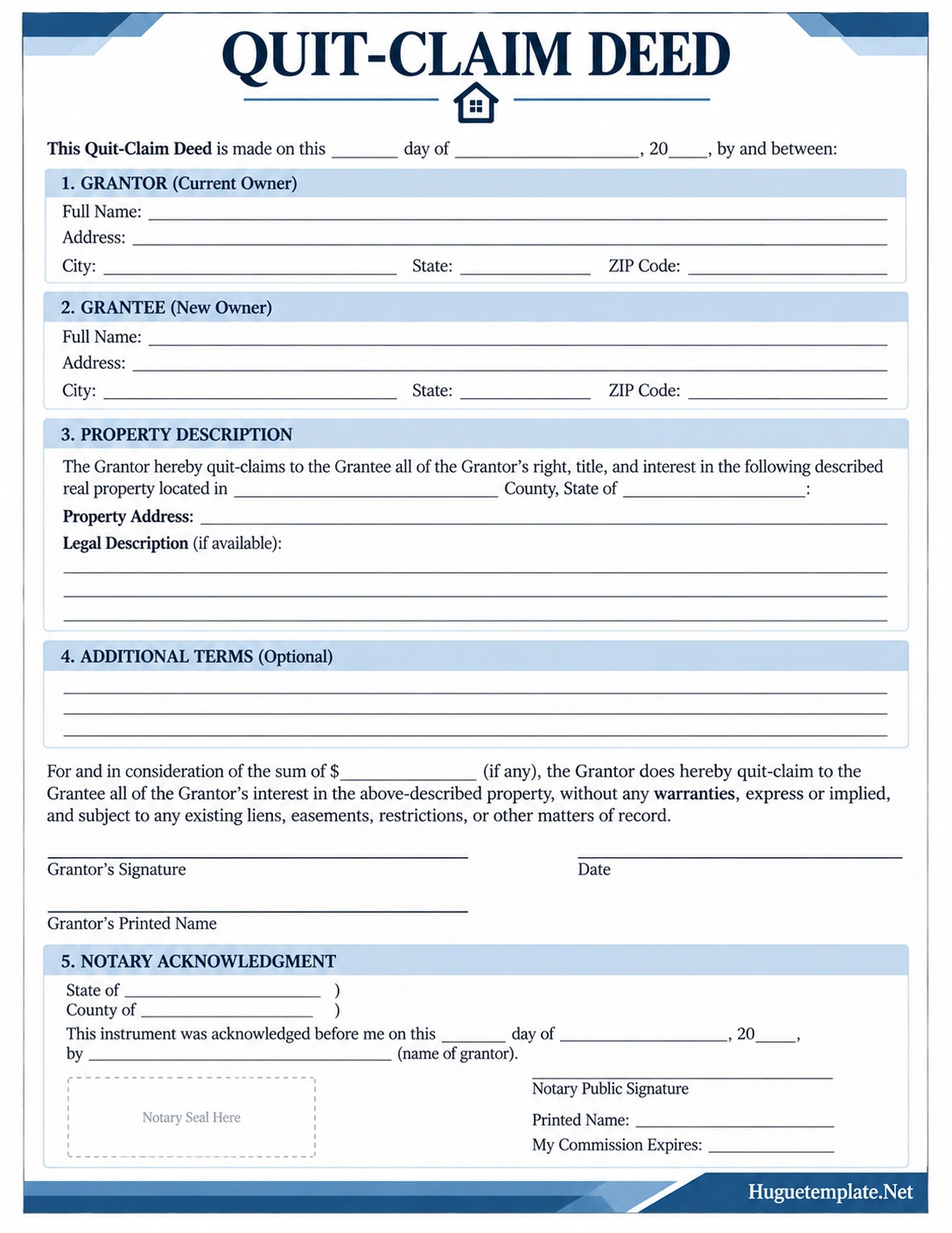
What Is a Quit-Claim Deed?
A quit-claim deed is a type of real estate deed used to transfer the grantor’s interest in property to a grantee. The important distinction is that the grantor generally makes no warranty about the quality of the title.
In simple terms, the grantor transfers whatever ownership interest they have, if any, rather than promising that they have complete ownership or that the property is free from competing claims.
This makes a quit-claim deed different from a warranty deed, which generally provides stronger assurances concerning title depending on the type of warranty and applicable state law.
How Does a Quit-Claim Deed Work?
A quit-claim deed generally identifies the person transferring the interest, the person receiving the interest, and the property involved. The grantor signs the deed, and the document is typically acknowledged before a notary public according to applicable requirements.
After execution, the deed may need to be recorded with the appropriate county or local land records office. Recording requirements, fees, tax forms, formatting rules, and supporting documents vary by jurisdiction.
The key point is that signing a quit-claim deed does not automatically guarantee that the grantee receives clear title. The deed transfers the grantor’s interest, subject to applicable legal and title issues.
What Is a Quit-Claim Deed Form Used For?
A quit-claim deed form can be appropriate for certain straightforward transfers where the parties understand the property’s ownership situation and do not require a warranty of title.
Common examples include:
- Transfers between family members
- Adding a spouse to a property title
- Removing a former spouse from a title when appropriate
- Certain transfers following a divorce
- Transfers between people who already understand the property’s title history
- Correcting or changing certain ownership interests
- Transfers involving a trust or related entity when legally appropriate
The suitability of a quit-claim deed depends on the specific circumstances. A transfer involving an unknown or unrelated party may require more careful title review and legal advice.
Key Parts of a Quit-Claim Deed Form
A quit-claim deed typically contains several important pieces of information. Exact requirements differ between jurisdictions, so the appropriate local form and instructions should always be checked.
Grantor Information
The grantor is the person or entity transferring an interest in the property. The deed generally identifies the grantor using the name required by the applicable recording authority.
Grantee Information
The grantee is the person or entity receiving the interest. The deed should clearly identify the new owner or recipient according to applicable local requirements.
Property Description
The deed needs to identify the property being transferred. This may include the property address as well as a legal description, parcel number, or other identifying information required by the local recording office.
A property address alone may not always be sufficient for recording purposes. The exact requirements should be confirmed with the relevant local authority.
Consideration
Some quit-claim deeds include information about consideration, meaning something of value exchanged in connection with the transfer. The required wording and tax treatment can vary significantly by jurisdiction and transaction.
Grantor’s Signature
The grantor generally signs the deed according to applicable state requirements. Some jurisdictions may have additional signature or witness requirements.
Notary Acknowledgment
A quit-claim deed commonly includes a notarial acknowledgment section. The notary verifies the signer’s identity and completes the applicable notarial certificate according to local law.
Quit-Claim Deed vs. Warranty Deed
The primary difference between a quit-claim deed and a warranty deed is the level of protection concerning title.
A quit-claim deed generally transfers whatever interest the grantor has without promising that the title is clear. A warranty deed generally provides greater assurances about ownership and title, although the precise warranties depend on the type of deed and applicable law.
- Quit-claim deed: Transfers the grantor’s interest without a general warranty of title.
- Warranty deed: Generally provides stronger title assurances to the grantee.
- Quit-claim deed: Often used when the parties understand and accept the title situation.
- Warranty deed: More commonly associated with transactions where the buyer expects title protection.
The appropriate deed should be selected based on the transaction rather than simply choosing the easiest form.
Advantages of Using a Quit-Claim Deed
There are situations where a quit-claim deed can be a practical option.
- Simple structure: The document can be relatively straightforward compared with more detailed conveyance documents.
- Useful for known parties: It can be practical when the parties already understand the property’s ownership history.
- Suitable for certain family transfers: Family members may use quit-claim deeds for specific ownership changes.
- Can facilitate title changes: It may be useful when adding or removing an ownership interest in appropriate circumstances.
- Useful in certain divorce-related transfers: A quit-claim deed may be part of an ownership change following a divorce, subject to applicable legal requirements.
These advantages do not eliminate the need to check local recording rules or consider possible title, tax, mortgage, and legal consequences.
Potential Risks of a Quit-Claim Deed
A quit-claim deed is not appropriate for every property transfer. Its limited title protection is one of the most important factors to understand before using one.
No General Guarantee of Clear Title
The grantor generally does not guarantee that they own the property free and clear of other claims. If the grantor has limited or defective ownership, the grantee may receive only that limited interest.
Existing Liens and Claims
A quit-claim deed generally does not automatically eliminate mortgages, liens, easements, restrictions, or other interests affecting the property.
Mortgage Issues
Changing the name on a deed does not necessarily change the obligations under an existing mortgage. Anyone considering a transfer involving financed property should check the loan documents and obtain appropriate professional advice.
Tax and Recording Consequences
Property transfers can have tax, transfer fee, filing, and recording implications. These vary by jurisdiction and transaction, so the applicable local requirements should be reviewed before the deed is executed.
How to Fill Out a Quit-Claim Deed Form
When using a quit-claim deed form, accuracy is essential. A mistake in the parties’ names or property description can create unnecessary problems.
1. Identify the Grantor
Enter the grantor’s legal name as required by the applicable records and instructions.
2. Identify the Grantee
Enter the recipient’s information accurately. The deed may also need information about how the grantee will hold title, depending on state requirements.
3. Describe the Property
Enter the property’s legal description and any other information required by the local recording authority. Do not rely solely on an informal description if a legal description is required.
4. Complete Required Transfer Information
Provide any consideration, exemption, tax, mailing address, or other information required for recording in the relevant jurisdiction.
5. Sign the Deed Properly
The grantor should sign the document using the procedure required by the applicable jurisdiction. Do not assume that requirements are identical across states.
6. Complete the Notarization
If notarization is required, the appropriate notarial acknowledgment should be completed by a qualified notary public.
7. Record the Deed
Submit the executed deed to the appropriate recording office when required. Check current filing fees, formatting requirements, supporting documents, and recording procedures before submission.
When Should You Consider Legal Advice?
Although a quit-claim deed may appear simple, real estate transfers can have significant legal and financial consequences. Professional advice can be particularly important when the ownership situation is complicated.
Consider obtaining advice from a qualified real estate attorney or other appropriate professional when:
- The property has multiple owners.
- There is a dispute about ownership.
- The property has a mortgage or other liens.
- The transfer is connected to a divorce or separation.
- The parties are not familiar with the property’s title history.
- The transfer involves a trust, estate, corporation, or other legal entity.
- There may be significant tax consequences.
- The receiving party is concerned about title defects.
Tips for Using a Quit-Claim Deed Form
- Check local requirements: Recording standards vary by state and county.
- Use accurate legal names: Confirm the names of the grantor and grantee before signing.
- Verify the property description: Use the correct legal description when required.
- Review the title: Understand existing ownership interests, liens, and restrictions.
- Check mortgage requirements: A deed transfer may not change an existing loan obligation.
- Confirm notarization requirements: Follow the applicable state procedure.
- Check recording requirements: Confirm fees, forms, formatting, and supporting documents.
- Keep copies: Retain a copy of the completed document and related records.
Common Quit-Claim Deed Mistakes to Avoid
Several errors can cause delays or create uncertainty about a property transfer.
- Using the wrong legal names
- Providing an incomplete property description
- Assuming the property address is always sufficient
- Failing to follow local recording requirements
- Assuming a quit-claim deed removes an existing mortgage
- Ignoring liens or other title interests
- Using an outdated form without checking current requirements
- Failing to obtain required notarization
- Assuming a quit-claim deed guarantees clear title
Frequently Asked Questions About Quit-Claim Deed Forms
What is a quit-claim deed form?
A quit-claim deed form is a document used to transfer whatever ownership interest a grantor may have in real property to a grantee without providing a general warranty of title.
Does a quit-claim deed give the buyer clear title?
No. A quit-claim deed generally does not guarantee clear title. The grantee typically receives only whatever interest the grantor has in the property, subject to applicable claims and interests.
When is a quit-claim deed commonly used?
It is commonly used for certain transfers between family members, some divorce-related transfers, adding or removing an ownership interest, and other situations where the parties understand the property’s title situation.
Does a quit-claim deed remove someone from a mortgage?
Not necessarily. A deed changes an ownership interest in real property, while a mortgage or loan is a separate obligation. Removing a person’s name from a deed does not automatically release that person from a mortgage.
Does a quit-claim deed need to be notarized?
Many jurisdictions require notarization for recording a deed, but the exact requirements vary. Check the rules of the state and recording office involved in the transfer.
Does a quit-claim deed need to be recorded?
Recording requirements vary by jurisdiction. Recording can be important for establishing the transfer in the public land records, so the applicable local requirements should be confirmed.
Can a quit-claim deed be used between family members?
Yes. Transfers between family members are among the situations in which quit-claim deeds may be used, provided the deed is appropriate for the specific circumstances and complies with local requirements.
Can I use a generic quit-claim deed form?
A generic template can help explain the typical structure of a quit-claim deed, but real estate recording requirements vary by jurisdiction. Before using a form for an actual transfer, verify that it meets the current requirements of the relevant state and county.
Conclusion
A quit-claim deed form provides a relatively straightforward way to transfer a person’s interest in real property without making a general warranty about the property’s title. It can be useful for certain transfers between people who already understand and trust each other, including some family, divorce, and title-change situations.
However, a quit-claim deed does not guarantee clear title and does not automatically eliminate mortgages, liens, or other property interests. Because real estate laws and recording requirements vary by jurisdiction, the document should be prepared and recorded according to the applicable local rules.
A printable quit-claim deed template can help organize the basic information, but it should always be reviewed against current state and county requirements before being used for an actual property transfer.
Download: Quit-Claim Deed Form
