A scholarship recommendation letter is an important document that helps a scholarship committee understand an applicant’s academic ability, personal character, leadership potential, and commitment to future goals. It provides an independent perspective that supports the information presented in a scholarship application.
Whether you are a teacher, professor, employer, mentor, or community leader, writing an effective scholarship recommendation letter requires specific examples and an honest assessment of the applicant. A strong letter explains why the student deserves consideration and how the scholarship could support their educational journey.
In this guide, you will learn what to include in a scholarship recommendation letter, how to structure it professionally, and how to write a convincing recommendation. You will also find a sample letter, practical writing tips, and answers to frequently asked questions.
What Is a Scholarship Recommendation Letter?
A scholarship recommendation letter is a formal letter written by someone who can evaluate an applicant’s qualifications, character, and potential. It supports a scholarship application by providing details that may not be fully reflected in grades, test scores, or a resume.
The recommender may be a teacher, academic advisor, professor, employer, research supervisor, or community leader. The most appropriate person is someone who knows the applicant well enough to provide specific and credible examples.
Scholarship committees often consider several factors when evaluating candidates, including academic achievement, leadership, community involvement, perseverance, and alignment with the scholarship’s mission. A thoughtful recommendation connects these qualities to the applicant’s demonstrated experience.
Why Is a Scholarship Recommendation Letter Important?
A strong recommendation can give a scholarship committee a clearer picture of the applicant as a student and individual. It adds context to an application and explains why the candidate may be a good fit for the award.
- Provides an independent perspective: The recommender offers an informed assessment of the applicant’s strengths.
- Highlights personal qualities: The letter can demonstrate integrity, responsibility, persistence, and intellectual curiosity.
- Supports academic achievements: Specific examples show how the student approaches challenging work.
- Demonstrates leadership potential: Relevant experiences can illustrate teamwork, initiative, and community involvement.
- Connects the applicant to the scholarship: The letter explains how the candidate’s goals and values align with the award’s purpose.
A recommendation letter should complement the application rather than simply repeat a transcript or resume. Specific observations and genuine examples make the recommendation more useful to the selection committee.
Who Should Write a Scholarship Recommendation Letter?
The ideal recommender depends on the scholarship’s eligibility criteria and the applicant’s background. Before agreeing to write a letter, consider whether you can provide an accurate and meaningful assessment of the candidate.
Teachers and Professors
Teachers and professors are suitable recommenders for academic scholarships because they can discuss classroom performance, research ability, intellectual curiosity, and commitment to learning.
They can also explain how an applicant has improved over time, responded to feedback, or contributed to a collaborative learning environment.
Employers and Supervisors
An employer or supervisor may be an appropriate choice for scholarships that value professional experience, career development, responsibility, or leadership.
They can describe the applicant’s reliability, communication skills, problem-solving ability, and contributions to a team or organization.
Mentors and Community Leaders
Mentors, volunteer coordinators, and community leaders can provide useful examples of service, initiative, personal growth, and commitment to community improvement.
However, applicants should check the scholarship requirements before selecting a recommender. Some programs require academic references and may not accept personal recommendations.
What to Include in a Scholarship Recommendation Letter
A professional scholarship recommendation letter should follow a clear structure. Each section should help the committee understand the relationship between the recommender and applicant and explain why the candidate deserves consideration.
1. Professional Letterhead and Contact Information
Begin with the recommender’s name, title, organization, and professional contact information when appropriate. Add the date and the recipient’s details if they are known.
For an online submission, follow the scholarship provider’s instructions. Some programs require a signed letter on official letterhead, while others use an online recommendation form.
2. Formal Greeting and Introduction
Address the scholarship committee or named recipient professionally. In the opening paragraph, identify the applicant, explain your relationship with them, and state that you recommend them for the scholarship.
If possible, mention how long you have known the student and in what capacity. This establishes the context for your assessment.
3. Academic Strengths and Achievements
Describe relevant academic accomplishments, research projects, classroom contributions, or examples of intellectual growth. Avoid relying only on broad statements such as “excellent student” or “hardworking individual.”
Instead, explain what the applicant did and why it demonstrates potential. A specific example of persistence during a difficult project is often more persuasive than a general compliment.
4. Character and Personal Qualities
Discuss qualities that are relevant to the scholarship, such as integrity, resilience, initiative, responsibility, curiosity, or compassion.
Support these qualities with observations from your own experience. If you describe a student as a strong leader, explain how they organized a project, supported classmates, or took responsibility for a shared goal.
5. Leadership and Community Involvement
If relevant, describe the applicant’s participation in volunteer activities, student organizations, research teams, or community initiatives.
Focus on the applicant’s actual contribution rather than merely listing memberships. Explain how their involvement demonstrates commitment, collaboration, or a willingness to make a positive difference.
6. Scholarship Suitability and Closing Endorsement
Explain why the applicant is a strong match for the scholarship’s purpose. Connect their demonstrated qualities, educational plans, or career goals to the values of the awarding organization.
End with a clear recommendation and offer to provide additional information if needed. Include your professional title and signature according to the submission requirements.
Scholarship Recommendation Letter Sample
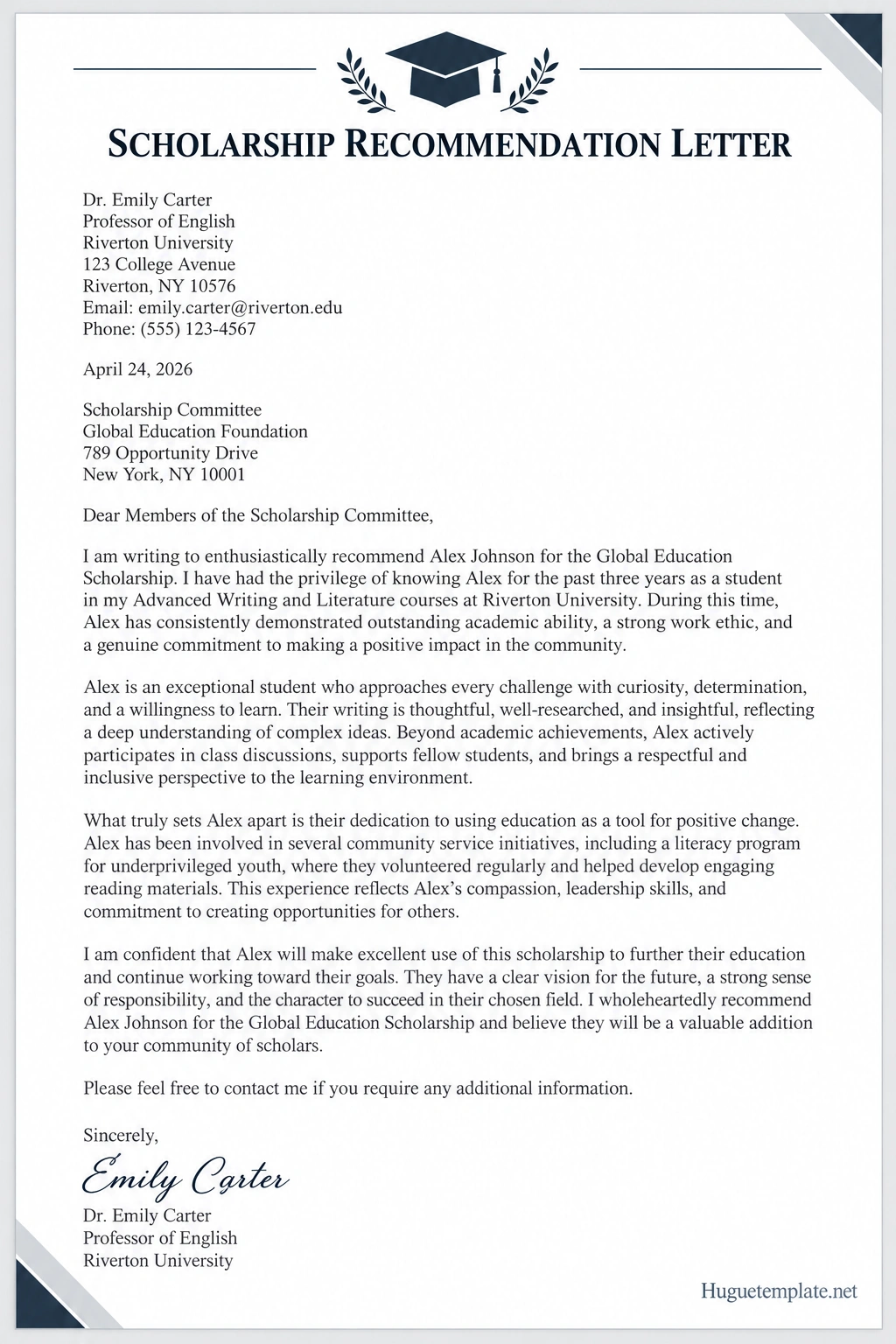
The following example demonstrates how to combine academic performance, personal qualities, and relevant achievements into a formal recommendation. The names, institution, and circumstances are fictional and should be replaced with accurate information.
Sample Letter for a Student Scholarship
Dr. Emily Carter
Professor of English, Riverton University
123 College Avenue, Riverton, NY 10576
April 24, 2026
Scholarship Committee
Global Education Foundation
Dear Members of the Scholarship Committee,
I am pleased to recommend Alex Johnson for the Global Education Scholarship. I have known Alex for three years as a student in my advanced writing and literature courses at Riverton University. During this time, Alex has consistently demonstrated academic commitment, intellectual curiosity, and a genuine interest in contributing positively to the learning community.
Alex approaches challenging assignments with care and determination. Their research is thoughtful, their writing is well organized, and they respond constructively to feedback. I have also observed their willingness to support fellow students and contribute respectfully to classroom discussions.
Beyond academic performance, Alex has demonstrated a strong commitment to community service. Through participation in a local literacy initiative, Alex has helped support educational activities for younger learners. This involvement reflects a sense of responsibility and a desire to make learning more accessible to others.
I believe Alex would make excellent use of this scholarship to continue developing academically and professionally. Their dedication, curiosity, and commitment to community involvement align well with the goals of the Global Education Foundation.
I recommend Alex Johnson with confidence. Please feel free to contact me if you require any additional information.
Sincerely,
Dr. Emily Carter
Professor of English
Riverton University
This sample illustrates the structure and tone of a scholarship recommendation letter. A real letter should reflect the recommender’s firsthand knowledge and include only verified details about the applicant.
How to Write a Scholarship Recommendation Letter Step by Step
Step 1: Review the Scholarship Requirements
Ask the applicant for the scholarship description, eligibility criteria, submission deadline, and any specific questions the committee wants the recommender to address.
Understanding the award’s purpose helps you decide which experiences and qualities to emphasize.
Step 2: Gather Relevant Information
Request the applicant’s resume, academic background, achievements, educational goals, and application materials when appropriate. You can also ask why the scholarship matters to them and which experiences best demonstrate their qualifications.
Use these materials as background information, but base your evaluation on facts you can verify and experiences you can honestly discuss.
Step 3: Choose Specific Examples
Select two or three meaningful examples that demonstrate the applicant’s strengths. These may involve academic work, leadership, research, volunteering, employment, or overcoming a significant challenge.
Explain the situation, the applicant’s contribution, and what it reveals about their abilities or character. This makes the letter more credible and memorable.
Step 4: Connect the Examples to the Scholarship
Identify how the applicant’s demonstrated qualities align with the award’s goals. For an academic scholarship, you might emphasize intellectual curiosity and persistence. For a community-focused award, service and leadership may be more relevant.
Avoid generic praise that could apply to any applicant. Make the recommendation specific to the individual and scholarship.
Step 5: Write Clearly and Professionally
Use a formal but natural tone. Organize the letter into short paragraphs, avoid unnecessary repetition, and maintain a consistent style throughout.
A one-page letter is often sufficient, although the scholarship provider’s word limit or submission instructions should take priority.
Step 6: Proofread and Submit on Time
Check the applicant’s name, scholarship title, dates, achievements, and contact details. Confirm that the letter meets the required format and submission process.
Submit the recommendation before the deadline and preserve a copy if appropriate. If you cannot provide a meaningful recommendation, it is better to decline politely than to submit a vague or unsupported endorsement.
Tips for Writing a Strong Scholarship Recommendation
Use these practical guidelines to make your letter more persuasive and useful to the selection committee.
- Be specific: Include firsthand examples rather than relying on generic praise.
- Stay honest: Describe genuine strengths and avoid exaggerating achievements.
- Show the applicant’s potential: Explain how their qualities may support future academic or professional success.
- Follow the scholarship criteria: Emphasize the qualities the awarding organization values.
- Maintain a professional tone: Use clear language and an appropriate formal greeting.
- Avoid unnecessary repetition: Do not simply restate information already covered in the application.
- Protect personal information: Include sensitive details only when relevant, authorized, and appropriate.
- Meet the deadline: Allow time for revisions and follow the requested submission method.
Common Mistakes to Avoid
Even a positive recommendation can be less effective if it lacks focus or contains avoidable errors. Watch for these common problems.
- Using vague compliments: Explain why the applicant is hardworking, responsible, or talented.
- Repeating the resume: Add personal observations that provide context beyond a list of achievements.
- Ignoring the scholarship’s purpose: Tailor the letter to the award’s selection criteria.
- Including unverified claims: Confirm facts and avoid inventing awards, grades, or activities.
- Writing an overly long letter: Focus on the most relevant examples and follow any word limit.
- Submitting a generic letter: Personalize the content to reflect the applicant’s genuine strengths.
Frequently Asked Questions About Scholarship Recommendation Letters
Who should write a scholarship recommendation letter?
A teacher, professor, academic advisor, employer, mentor, or community leader may be suitable, depending on the scholarship requirements. Choose someone who knows the applicant well and can provide specific examples of their abilities and character.
How long should a scholarship recommendation letter be?
A letter of approximately one page is often appropriate. However, always follow the scholarship provider’s instructions if it specifies a word count, page limit, or online submission format.
What makes a scholarship recommendation letter strong?
A strong letter combines a credible relationship with the applicant, specific examples of achievement, an honest assessment of character, and a clear explanation of why the student fits the scholarship’s purpose.
Can a friend or family member write a scholarship recommendation letter?
It depends on the scholarship’s rules. Many programs prefer academic or professional references who can provide an objective assessment. Applicants should check the eligibility requirements before choosing a personal reference.
Should a scholarship recommendation letter mention financial need?
Only when financial need is relevant to the scholarship and the recommender has appropriate, verified information. Avoid including private financial details without the applicant’s permission. The letter should focus on the criteria the committee asks the recommender to address.
Can I use a scholarship recommendation letter template?
Yes. A template can help organize the letter’s introduction, supporting examples, scholarship fit, and closing. However, the final letter should be personalized and based on the recommender’s genuine knowledge of the applicant.
How far in advance should I request a recommendation letter?
Request the letter several weeks before the deadline whenever possible. Providing the scholarship requirements and relevant background information early gives the recommender time to prepare a thoughtful recommendation.
What should I do if I cannot recommend the applicant strongly?
If you cannot provide a positive and credible assessment, explain politely that you may not be the best person to write the letter. This gives the applicant time to seek a more suitable recommender.
Conclusion
A scholarship recommendation letter helps a selection committee understand an applicant’s academic ability, character, achievements, and potential beyond the information presented in an application. The strongest letters use specific examples to demonstrate why the candidate is a suitable choice for the award.
Start by reviewing the scholarship requirements, gathering relevant background information, and selecting examples that show the applicant’s genuine strengths. Then write a clear, professional letter that connects those qualities to the scholarship’s purpose.
Whether you are recommending a student for an academic award, community scholarship, or professional development opportunity, an honest and personalized recommendation can provide valuable context for the committee’s decision.
Download: Scholarship Recommendation Letter Template
