A project estimate is a structured forecast of the time, cost, materials, labor, and other resources needed to complete a project. It helps project managers, contractors, business owners, and clients understand what a project may require before work begins.
A clear estimate can support better planning and decision-making. By identifying expected expenses, labor requirements, project tasks, and estimated completion times in advance, teams can establish realistic expectations and prepare an appropriate budget.
A project estimate template provides a convenient way to organize these details in one document. It can be customized for construction projects, business projects, freelance work, home improvements, marketing projects, software development, and many other types of work.
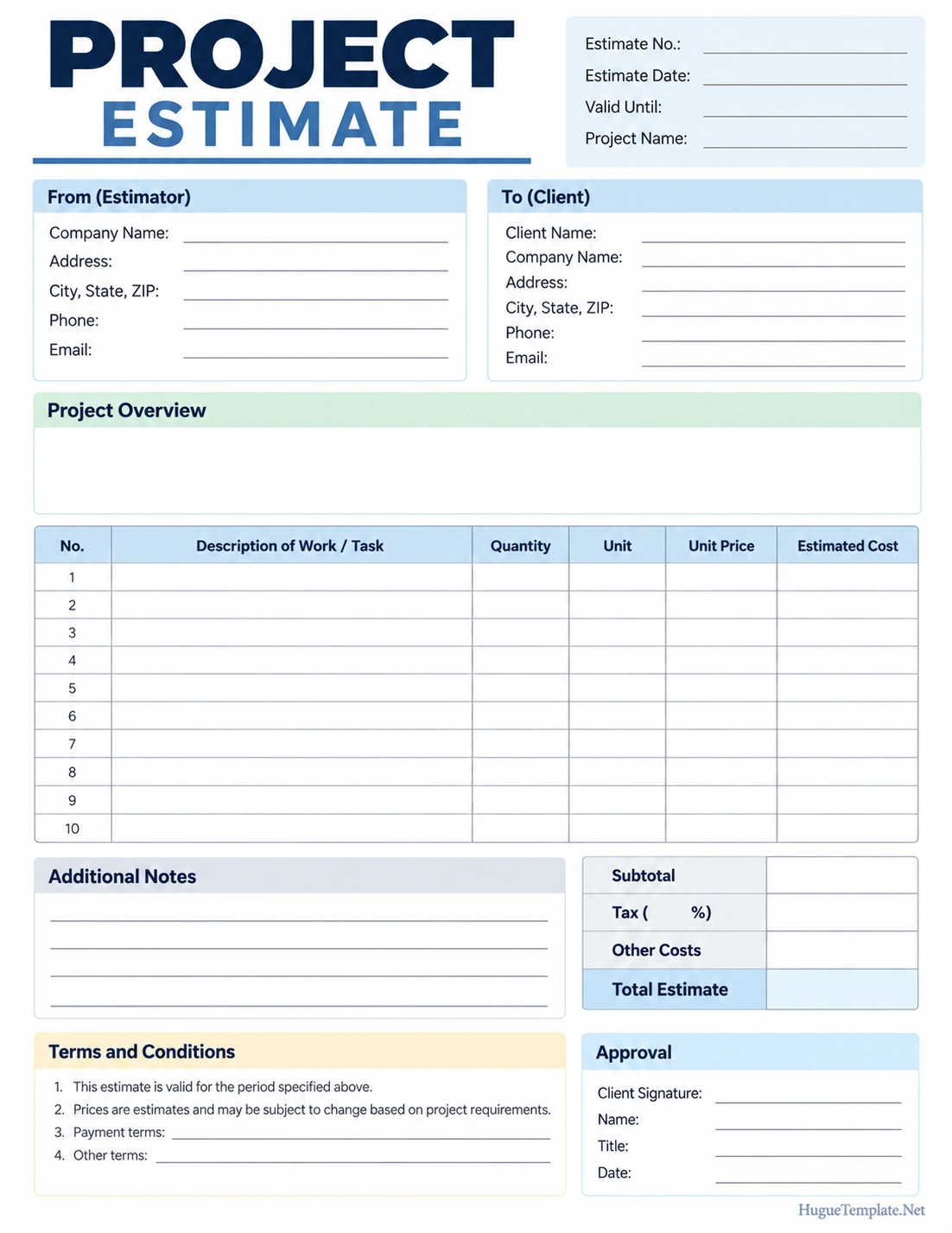
What Is a Project Estimate?
A project estimate is a prediction of the resources and costs required to complete a specific project. It may include estimated labor hours, materials, equipment, services, expenses, project duration, and other costs.
The purpose of an estimate is not necessarily to predict the final result down to the exact dollar or hour. Instead, it provides a reasonable forecast that can be used to plan the project and make informed decisions.
A project estimate may include:
- Project name and description
- Client or customer information
- Project tasks and deliverables
- Estimated labor hours
- Labor rates
- Materials and quantities
- Equipment or service costs
- Additional expenses
- Estimated project duration
- Contingency allowance
- Subtotal and estimated total
Why Is Project Estimation Important?
Project estimation provides a foundation for planning before resources are committed. Without an estimate, it can be difficult to determine whether a project is financially practical, adequately staffed, or achievable within the expected timeframe.
Supports Budget Planning
An estimate gives project stakeholders an early view of expected costs. This can help determine whether the available budget is sufficient and whether adjustments are needed before work begins.
Helps Allocate Resources
Estimating labor, materials, equipment, and other resources helps project managers determine what will be needed to complete the planned work.
Improves Scheduling
Time estimates can help establish a realistic project schedule. Understanding how long individual tasks may take can make it easier to organize milestones and deadlines.
Supports Client Communication
For client-facing projects, an estimate can provide a clear summary of expected costs and deliverables. This allows the client to review the proposed scope before approving the work.
Identifies Potential Risks
The estimation process can reveal areas of uncertainty, resource constraints, or tasks that may require additional time or expense. Identifying these issues early can improve project planning.
What Should a Project Estimate Include?
The information included in an estimate depends on the project. However, a well-organized document generally contains several core sections.
1. Project Information
Start with basic details such as the project name, estimate number, date, client name, project manager, and contact information.
2. Project Scope
Briefly describe what the project includes. A clear scope helps establish what is being estimated and can reduce confusion about which tasks are included.
3. Task Breakdown
List the major activities required to complete the project. Breaking a project into smaller tasks can make estimating labor and resources easier.
4. Labor Estimate
Record the expected labor hours and applicable labor rates. If several roles are involved, list them separately so the calculation is easier to review.
5. Materials and Supplies
Identify the materials, supplies, or other physical resources required for the project. Include estimated quantities and unit costs when appropriate.
6. Equipment and Services
Some projects require rented equipment, subcontractors, software, transportation, or professional services. These expenses can be included as separate line items.
7. Additional Expenses
Consider other project-related expenses such as shipping, permits, travel, administrative costs, or other applicable charges.
8. Project Timeline
Include an estimated start date, completion date, duration, or major milestones when timing is an important part of the project.
9. Total Estimated Cost
Calculate the projected total by combining the applicable labor, materials, equipment, services, and additional expenses.
How to Create a Project Estimate
Creating a useful project estimate starts with understanding the scope of work and breaking the project into manageable components.
Step 1: Define the Project Scope
Start by identifying what the project is expected to accomplish. Clearly define the deliverables, major tasks, and boundaries of the work.
Step 2: Break the Project Into Tasks
Divide the project into individual activities or work packages. Smaller components are generally easier to estimate than one large, undefined task.
Step 3: Estimate Labor
Determine how many hours each task may require. If multiple people or roles are involved, estimate the hours for each separately.
Step 4: Estimate Materials and Resources
List the materials, equipment, software, subcontractors, or other resources needed. Estimate quantities and costs based on the information currently available.
Step 5: Calculate Direct Costs
Add the estimated labor, materials, equipment, and other direct project expenses.
Step 6: Consider Additional Costs
Review the project for expenses that may not be immediately visible. Depending on the project, these may include transportation, permits, administrative work, or specialist services.
Step 7: Add an Appropriate Contingency
Projects can involve uncertainty. When appropriate, a contingency amount can account for reasonable unknowns or unexpected costs. The amount should reflect the nature and level of uncertainty rather than being added without consideration.
Step 8: Review the Estimate
Check the calculations, assumptions, quantities, labor hours, and project scope before presenting the estimate to stakeholders or the client.
Types of Project Estimates
Different projects may require different estimation approaches. The appropriate method depends on how much information is available and how far the project has progressed.
Preliminary Estimate
A preliminary estimate is prepared during the early planning stage when many project details may still be uncertain. It provides an initial indication of expected resources and costs.
Detailed Estimate
A detailed estimate is based on a more complete project scope and typically includes individual tasks, labor, materials, quantities, rates, and other costs.
Labor Estimate
A labor estimate focuses primarily on the time and personnel required to complete the work. It can be especially useful for service businesses, consulting, freelance projects, and labor-intensive work.
Construction Project Estimate
Construction estimates may include materials, labor, equipment, subcontractors, permits, site-related expenses, and other project costs.
Fixed-Price Project Estimate
A fixed-price estimate provides a proposed price for completing a defined scope of work. The estimate should clearly identify what is included and any assumptions or exclusions.
Project Estimate vs. Project Budget
A project estimate and a project budget are related but serve different purposes.
A project estimate forecasts what the project is expected to cost based on the available information. A project budget establishes the approved amount allocated for the project and becomes a reference point for managing actual spending.
For example, a team may prepare an estimate of $25,000 during planning. After reviewing the estimate, management may approve a project budget of $24,000 or $27,000 depending on financial priorities and available resources.
Once the project begins, actual costs can be compared with both the estimate and the approved budget.
Project Estimate vs. Quote
A project estimate is generally a forecast of expected project costs. A quote is often a more formal price provided to a customer for specified goods or services.
The distinction can vary by industry and business practice. In client-facing work, it is important to explain whether a document is an informal estimate, a formal quotation, or another type of commercial proposal.
How to Improve Project Estimate Accuracy
No estimate can eliminate uncertainty completely, but a structured process can improve the quality of the forecast.
Use Historical Project Data
Previous projects can provide useful reference points for estimating labor hours, material quantities, expenses, and project duration.
Break Large Tasks Into Smaller Activities
Estimating several smaller tasks can be more practical than assigning one large estimate to an entire phase of work.
Document Your Assumptions
Write down important assumptions behind the estimate. For example, an estimate may assume that materials will be available by a certain date or that the project scope will remain unchanged.
Consult Subject Matter Experts
Team members with direct experience performing the work can provide valuable input when estimating technical tasks or specialized activities.
Account for Uncertainty
Identify areas where costs or timelines are uncertain. Rather than hiding uncertainty, document it so stakeholders understand the basis of the estimate.
Update Estimates When Information Changes
As the project develops, new information may change the expected cost or timeline. Updating the estimate can provide stakeholders with a more current forecast.
Common Project Estimation Methods
Analogous Estimating
Analogous estimating uses information from a similar previous project as a reference for the current project. It can be useful when detailed information is limited.
Bottom-Up Estimating
Bottom-up estimating involves estimating individual tasks or components and then combining them into a total project estimate. This approach can provide more detail when the project scope is well defined.
Three-Point Estimating
Three-point estimating considers different scenarios, such as optimistic, most likely, and pessimistic outcomes. It can help communicate uncertainty around a forecast.
Parametric Estimating
Parametric estimating uses measurable relationships or historical rates to calculate expected costs or effort. For example, a project may estimate cost based on a known cost per unit.
Common Project Estimation Mistakes
A project estimate can become unreliable when important assumptions or costs are overlooked.
- Underestimating the scope: Make sure all major deliverables and tasks are considered.
- Ignoring indirect costs: Include relevant expenses beyond basic labor and materials.
- Using outdated information: Review rates, supplier prices, and historical data before estimating.
- Forgetting contingency: Consider reasonable uncertainty when appropriate.
- Failing to document assumptions: Explain the conditions behind important estimates.
- Overlooking dependencies: Consider tasks that must be completed before other work can begin.
- Not updating the estimate: Revise the forecast when significant project information changes.
Benefits of Using a Project Estimate Template
A reusable project estimate template can make the estimation process more organized and consistent.
- Saves time: Common estimation sections are already structured.
- Improves organization: Labor, materials, expenses, and totals can be recorded in one document.
- Supports consistency: Teams can use a familiar format across similar projects.
- Improves communication: Clients and stakeholders can see how the projected cost is organized.
- Creates a reference record: The estimate can be retained for future project planning and comparison.
How to Use a Printable Project Estimate Template
Begin by entering the project name, client information, estimate date, and other identifying details. Then describe the project scope and list the major tasks or deliverables.
For each task, estimate the required labor, materials, services, and other resources. Record quantities, rates, and projected costs where applicable.
After entering the individual costs, calculate the subtotal and include any appropriate additional expenses or contingency. Review the estimated project duration and important assumptions before finalizing the document.
If the estimate is being provided to a client, make sure the scope, assumptions, exclusions, pricing, and expected timeline are clearly understood before work begins.
Frequently Asked Questions About Project Estimates
What is a project estimate?
A project estimate is a forecast of the time, cost, labor, materials, and other resources expected to be required to complete a project.
What should a project estimate include?
A project estimate commonly includes project details, scope, tasks, labor, materials, equipment, additional expenses, timeline, assumptions, and total estimated cost.
Why is project estimation important?
Project estimation helps teams plan budgets, allocate resources, establish schedules, communicate expectations, and identify potential risks before project execution begins.
How accurate is a project estimate?
The accuracy of an estimate depends on the quality of the available information, project complexity, estimation method, assumptions, and level of uncertainty. Early estimates may be less precise than estimates prepared after the scope has been fully defined.
What is the difference between a project estimate and a project budget?
A project estimate forecasts expected project costs, while a project budget establishes the approved amount allocated for the project. Actual project spending can later be compared with both figures.
Can I use a project estimate template?
Yes. A project estimate template provides a structured starting point for documenting project scope, labor, materials, expenses, timeline, assumptions, and estimated totals. It should be customized for each project.
How can I make a project estimate more accurate?
You can improve estimation accuracy by defining the scope clearly, breaking work into smaller tasks, using historical project data, consulting experienced team members, documenting assumptions, and updating the estimate as new information becomes available.
Conclusion
A project estimate provides an important foundation for planning and managing a project. By forecasting labor, materials, expenses, resources, and time requirements, it helps teams and clients understand what may be required before committing to the work.
A well-organized project estimate template can simplify this process by bringing project scope, costs, resources, and timelines together in one document. The most useful estimates are based on clear assumptions, realistic information, and a well-defined project scope.
Because project conditions can change, an estimate should be treated as a forecast rather than a guarantee. Reviewing and updating it as the project develops can help keep expectations and planning aligned.
Download: Project Estimate Template
