Sales strategies provide a clear plan for turning business goals into measurable sales results. Instead of relying on random promotions or inconsistent outreach, a well-defined sales strategy helps a business identify the right customers, choose effective sales channels, organize daily activities, and measure performance.
A strong sales strategy can be useful for small businesses, startups, sales teams, service providers, and established companies. It creates a practical framework for reaching revenue goals while also building stronger and longer-lasting customer relationships.
The most effective approach is not necessarily to use every available sales technique. The goal is to choose strategies that match your target customers, products, sales cycle, resources, and business objectives. This guide explains how to create a practical sales strategy and turn it into specific actions.
What Are Sales Strategies?
Sales strategies are organized approaches that businesses use to attract prospects, convert leads into customers, increase sales, and achieve revenue objectives. A sales strategy connects business goals with specific customer groups, sales activities, channels, and performance measurements.
A sales strategy may include activities such as prospecting, direct outreach, email marketing, referrals, content marketing, product demonstrations, follow-ups, account management, and customer retention.
A useful sales strategy should answer several important questions:
- What sales goals do we want to achieve?
- Who are our ideal customers?
- What problems or needs do our customers have?
- What value does our product or service provide?
- Which sales channels should we use?
- What activities will generate qualified leads?
- How will we measure sales performance?
- What should we improve when results fall below expectations?
Why Are Sales Strategies Important?
Without a clear sales strategy, sales activities can become reactive and inconsistent. Team members may pursue different customer groups, use different messages, or spend time on activities that produce little return.
A defined strategy creates alignment and gives the sales team a common direction. It also makes it easier to identify what is working and where improvements are needed.
Creates Clear Sales Goals
A sales strategy turns broad business objectives into specific targets. Instead of simply saying that the company wants to increase sales, the team can establish measurable goals for revenue, new customers, sales volume, conversion rate, or customer retention.
Improves Customer Targeting
Understanding the ideal customer helps a sales team focus its time and resources. A clear target market can improve prospecting, messaging, lead qualification, and overall sales efficiency.
Creates Consistent Sales Activities
A sales plan gives team members a repeatable process for finding prospects, contacting leads, following up, presenting solutions, and closing opportunities.
Makes Performance Easier to Measure
When goals and activities are clearly defined, businesses can compare actual results with expected results. This makes it easier to identify successful tactics and adjust weak areas.
Key Elements of an Effective Sales Strategy
A complete sales strategy should connect goals, customers, actions, and measurements. The following elements provide a practical foundation for building one.
1. Sales Goals
Start by defining what the business wants to accomplish. Goals should be specific and measurable whenever possible.
Common sales objectives include:
- Increase monthly or annual revenue
- Generate more qualified leads
- Acquire new customers
- Increase average order value
- Improve conversion rates
- Increase repeat purchases
- Improve customer retention
- Expand into a new market
2. Target Customers
Identify the customers most likely to need and value your product or service. Consider factors such as industry, company size, location, demographics, purchasing behavior, budget, challenges, and buying motivations.
A clearly defined ideal customer profile helps the sales team avoid spending excessive time on prospects who are unlikely to become customers.
3. Value Proposition
Your sales strategy should clearly explain why a customer should choose your product or service. A strong value proposition focuses on customer needs and outcomes rather than simply listing product features.
For example, instead of focusing only on what a product contains, explain how it can save time, reduce complexity, solve a problem, improve efficiency, or provide another meaningful benefit.
4. Sales Channels
Choose the channels that best match your target audience and buying process. Depending on the business, sales channels may include websites, email, social media, direct sales, retail partners, distributors, referrals, events, or industry networks.
5. Sales Activities
Turn the overall strategy into specific actions. These activities might include contacting prospects, scheduling demonstrations, sending proposals, following up with leads, requesting referrals, publishing sales content, or contacting previous customers.
6. Performance Metrics
Define the key metrics that will show whether the sales strategy is working. Useful sales performance indicators include revenue, qualified leads, conversion rate, average deal size, sales cycle length, customer acquisition cost, and customer retention.
Sales Strategies Template
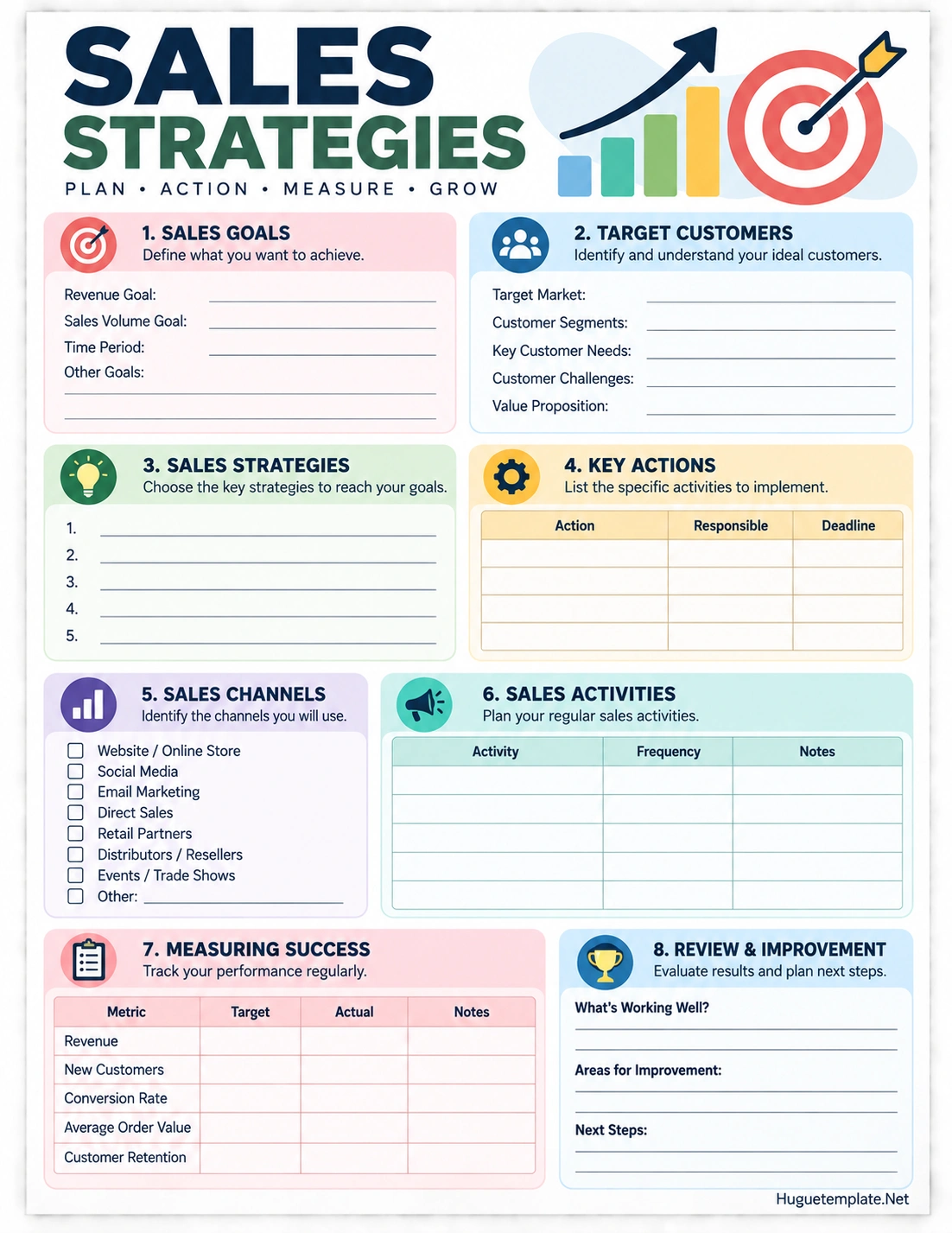
A printable sales strategy template can make the planning process more structured. Instead of keeping goals, customer information, sales activities, and performance measurements in separate documents, a template can bring the major components together in one organized worksheet.
Types of Sales Strategies
There is no single sales strategy that works for every business. Different approaches can be combined depending on the target market, product, sales cycle, and available resources.
Inbound Sales Strategy
Inbound sales focuses on attracting potential customers through useful content, search visibility, educational resources, social media, email marketing, and other channels. The objective is to help prospects discover the business and move toward a purchase decision.
Outbound Sales Strategy
Outbound sales involves proactively reaching potential customers. Common activities include cold outreach, direct sales calls, targeted emails, sales presentations, and personalized prospecting.
Relationship-Based Selling
Relationship-based selling emphasizes trust and long-term customer relationships. Sales professionals focus on understanding customer needs, providing helpful guidance, and maintaining communication beyond the initial purchase.
Referral Sales Strategy
Referral selling encourages satisfied customers, partners, or professional contacts to recommend the business to potential buyers. A structured referral process can turn existing relationships into a source of qualified leads.
Upselling and Cross-Selling
Upselling encourages customers to consider a higher-value version of a product or service, while cross-selling introduces complementary products or services. Both approaches can increase customer value when the recommendation genuinely matches the customer’s needs.
How to Create a Sales Strategy
Step 1: Define the Business Objective
Begin with the result you want to achieve. Set a specific revenue, customer acquisition, or sales growth target and establish the time period for reaching it.
Step 2: Identify Your Ideal Customers
Describe your ideal customer and understand their main problems, purchasing motivations, objections, and expectations. This information should influence your messaging and sales process.
Step 3: Choose Your Sales Channels
Select the channels where your target customers are most likely to respond. Focus on a manageable number of channels instead of trying to use everything at once.
Step 4: Define Your Core Sales Activities
List the actions required to reach your goals. Assign responsibilities, deadlines, and frequency where appropriate so the strategy becomes an actionable sales plan.
Step 5: Establish Performance Metrics
Decide which numbers will be reviewed regularly. For example, you might track new leads, qualified opportunities, proposals, closed deals, revenue, conversion rate, and customer retention.
Step 6: Review and Improve
Sales strategies should not remain unchanged forever. Review performance regularly and identify which activities generate the strongest results. Continue successful activities and adjust or remove tactics that consistently underperform.
Practical Tips for Better Sales Performance
A sales strategy becomes more effective when it is simple enough for the team to use consistently. Consider the following practices:
- Focus on a clearly defined target customer.
- Set measurable sales goals with realistic deadlines.
- Prioritize qualified leads instead of chasing every prospect.
- Use customer problems to guide your sales messaging.
- Follow up consistently without becoming intrusive.
- Record important customer interactions and next steps.
- Measure conversion rates at different stages of the sales process.
- Review sales results regularly with the team.
- Test new approaches rather than changing everything at once.
- Use customer feedback to improve your sales process.
How to Measure a Sales Strategy
Measuring sales performance helps determine whether your strategy is producing the desired results. The right metrics depend on the business model, but several indicators are widely useful.
Revenue
Revenue shows the direct financial result of sales activities and can be compared with the sales target for a specific period.
Conversion Rate
Conversion rate measures how many prospects move from one stage of the sales process to another. A low conversion rate can indicate problems with targeting, messaging, qualification, pricing, or the sales process.
Average Deal Size
Average deal size shows the typical value of completed sales. Increasing this metric can sometimes improve revenue without requiring the same increase in customer volume.
Customer Retention
Retention measures how effectively a business keeps existing customers. Strong customer relationships can support repeat purchases and long-term revenue.
Sales Cycle Length
Sales cycle length measures how long it takes to move a prospect from initial contact to a completed purchase. Understanding this metric can help businesses improve forecasting and identify delays in the sales process.
Common Sales Strategy Mistakes
Even a well-designed sales plan can fail when execution is inconsistent. Avoid strategies that are too broad, difficult to measure, or disconnected from customer needs.
- Targeting everyone: A broad audience can make sales messaging less relevant.
- Setting vague goals: Goals should be specific enough to measure.
- Ignoring follow-up: Many opportunities require consistent communication before a decision is made.
- Using too many channels: Spreading resources too thin can reduce effectiveness.
- Failing to measure results: Without performance data, it is difficult to know what should change.
- Focusing only on closing: Sustainable sales also depend on customer satisfaction and retention.
Sales Strategy vs. Sales Tactics
A sales strategy is the broader plan for achieving sales objectives, while sales tactics are the specific actions used to execute that plan.
For example, a business may have a strategy to increase sales among small businesses. Its tactics might include targeted email outreach, product demonstrations, referral programs, and follow-up calls.
The distinction is important because individual tactics should support the overall strategy rather than operate independently.
Frequently Asked Questions About Sales Strategies
What are sales strategies?
Sales strategies are structured plans that help businesses identify target customers, achieve sales goals, organize sales activities, and improve revenue performance. They provide direction for how a business will attract, convert, and retain customers.
What is the most effective sales strategy?
There is no single best sales strategy for every business. The most effective approach depends on the target market, product, customer needs, sales cycle, competition, and available resources. A combination of well-matched strategies often produces better results than using one tactic alone.
Why do businesses need a sales strategy?
A sales strategy helps businesses focus their resources, align sales activities with business goals, understand target customers, and measure performance. It can also make the sales process more consistent and easier to improve.
What should a sales strategy include?
A practical sales strategy should generally include sales goals, target customers, value proposition, sales channels, key sales activities, responsibilities, performance metrics, and a process for reviewing and improving results.
How often should a sales strategy be reviewed?
A sales strategy should be reviewed regularly based on the length of the sales cycle and the needs of the business. Monthly or quarterly reviews can help identify changes in customer behavior, sales performance, market conditions, and business priorities.
Can a small business use a sales strategy?
Yes. Small businesses can benefit from a simple sales strategy just as much as larger organizations. A small business can focus on a specific customer segment, a few effective sales channels, measurable goals, and consistent follow-up activities.
What is the difference between a sales strategy and a sales plan?
A sales strategy explains the overall approach for achieving sales objectives, while a sales plan typically translates that strategy into specific goals, activities, responsibilities, timelines, and measurements.
Conclusion
Effective sales strategies give businesses a practical framework for achieving revenue goals and building stronger customer relationships. By defining clear objectives, identifying ideal customers, selecting appropriate sales channels, organizing specific activities, and measuring performance, businesses can create a sales process that is easier to manage and improve.
The key is to keep the strategy focused and actionable. Use a clear sales strategy template to organize your goals, customers, activities, metrics, and next steps, then review the results regularly. With consistent execution and continuous improvement, a well-planned sales strategy can support stronger sales performance and sustainable business growth.
Download: Sales Strategies Template
