A personal financial statement helps you understand your financial position by showing what you own, what you owe, and how much your assets exceed your liabilities. Whether you are organizing your household finances, preparing for a loan application, or setting long-term financial goals, this document provides a useful snapshot of your finances at a specific point in time.
Creating a personal financial statement can also help you monitor changes in your net worth, review outstanding debt, and identify opportunities to improve your financial health. Lenders may request a personal financial statement when evaluating applications for mortgages, business loans, or other types of credit.
In this guide, you will learn what a personal financial statement is, what information to include, how to calculate net worth, and how to use a printable personal financial statement template to organize your financial records.
What Is a Personal Financial Statement?
A personal financial statement is a document that summarizes an individual’s or couple’s assets and liabilities on a particular date. It may also include identifying information, financial notes, and a summary of net worth. The document can be prepared as a spreadsheet, a printable worksheet, or a form supplied by a lender.
Assets are things you own that have financial value, such as cash, savings, investments, real estate, and vehicles. Liabilities are amounts you owe, including mortgage balances, student loans, auto loans, and credit card debt.
The difference between your total assets and total liabilities is your net worth. This figure offers a broad view of your financial position, although it does not show everything about your finances, such as monthly cash flow or how quickly you can access each asset.
A personal financial statement is usually prepared for a specific date. Keeping dated versions makes it easier to compare your financial position over time and see how savings, investments, debt repayment, and major purchases affect your net worth.
Free Printable Personal Financial Statement Template
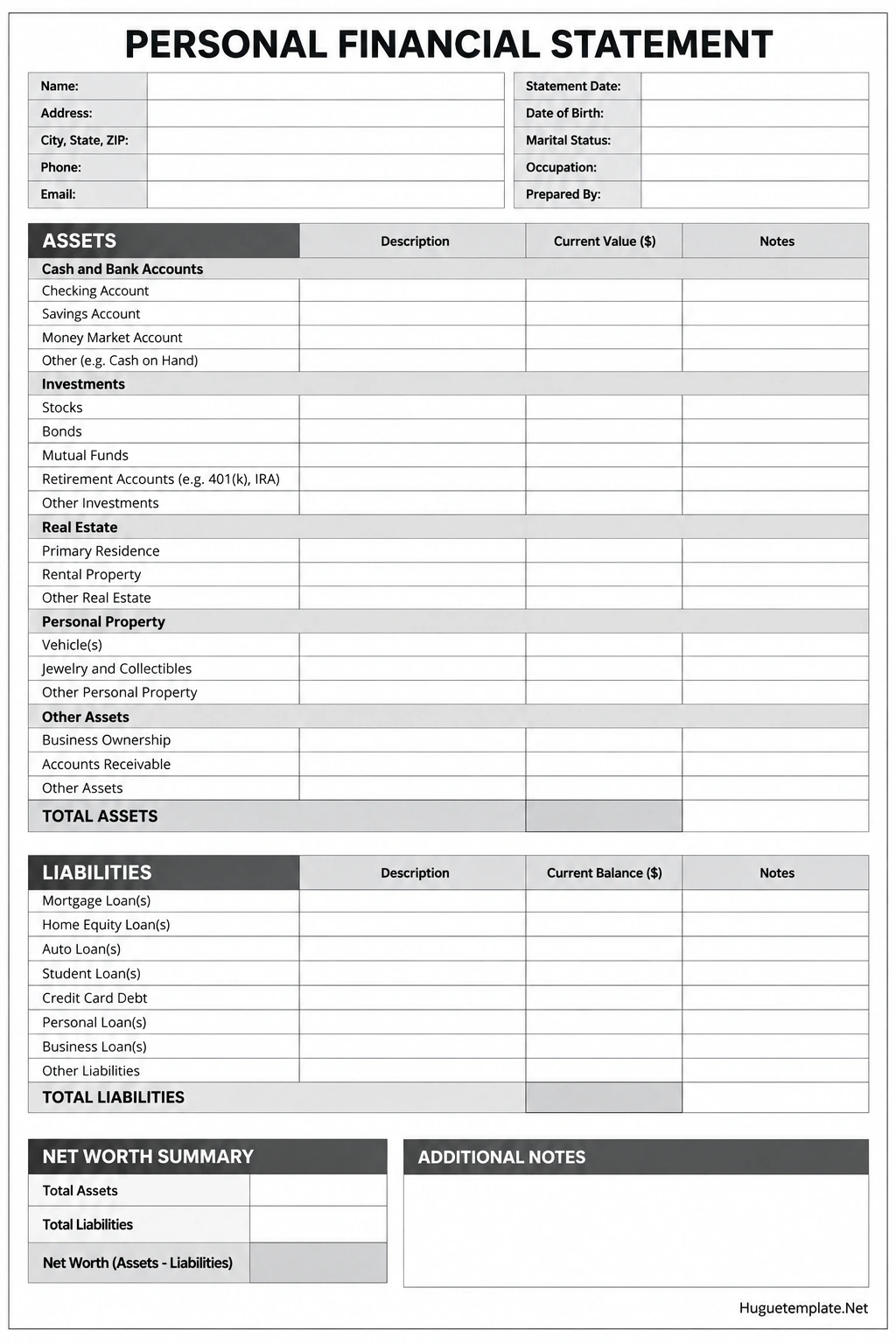
A printable personal financial statement template gives you a structured place to record your assets, liabilities, and net worth. Instead of creating a worksheet from scratch, you can use a ready-made layout to organize your financial information in a consistent format.
The template below includes personal information fields, categorized asset and liability sections, current-value columns, space for notes, and a net worth summary. You can print it to complete by hand or use it as a reference when preparing a digital spreadsheet.
Why Do You Need a Personal Financial Statement?
A personal financial statement is useful for more than loan applications. It can support financial planning, debt management, and regular reviews of your overall financial position.
1. Understand Your Net Worth
Calculating net worth helps you see the relationship between what you own and what you owe. Reviewing this figure periodically can help you evaluate whether your financial position is improving, staying stable, or becoming more leveraged.
2. Prepare for Loan Applications
Lenders may review a personal financial statement when assessing creditworthiness or evaluating a borrower’s assets and obligations. It can help them understand the applicant’s financial position, but the document is only one part of a lending decision. Requirements vary by lender and loan type.
3. Set Realistic Financial Goals
A current financial snapshot can help you set measurable goals, such as building emergency savings, reducing high-interest debt, increasing retirement contributions, or saving for a home. You can use later statements to measure progress toward those goals.
4. Review Debt and Financial Obligations
Listing liabilities in one place makes it easier to see outstanding balances across mortgages, personal loans, student loans, and credit cards. This overview can help you prioritize repayments and understand how debt affects your net worth.
5. Support Long-Term Financial Planning
When reviewed alongside a budget, income statement, and cash flow plan, a personal financial statement provides useful context for major financial decisions. It can help you assess whether you are prepared for a large purchase, a career change, or another important financial commitment.
What Should a Personal Financial Statement Include?
The exact format depends on your needs and whether a lender has supplied a specific form. For personal tracking, include the following categories where they apply to your situation.
Assets
Assets are resources you own that have financial value. Record a reasonable current value for each item and avoid counting the same asset more than once.
- Cash and bank accounts: Checking accounts, savings accounts, money market accounts, and cash on hand.
- Investments: Stocks, bonds, mutual funds, brokerage holdings, and other investments.
- Retirement accounts: Eligible retirement savings accounts, recorded at their current statement values.
- Real estate: Your primary residence, rental properties, and other property you own.
- Personal property: Vehicles, jewelry, collectibles, and other valuable belongings when appropriate.
- Business interests: Ownership interests in a business, using a reasonable valuation and avoiding double-counting assets already included elsewhere.
- Other assets: Receivables or additional resources with a measurable financial value.
Liabilities
Liabilities represent debts and other financial obligations. Use current outstanding balances rather than the original amount borrowed.
- Mortgage loans: The remaining balance on a home loan or other property mortgage.
- Home equity loans: Outstanding balances on loans secured by home equity.
- Auto loans: The amount still owed on vehicles.
- Student loans: Current balances on education-related loans.
- Credit card debt: Outstanding balances on credit cards.
- Personal loans: Unpaid balances on personal borrowing.
- Business loans: Business-related obligations for which you are personally responsible or that the statement specifically requires you to disclose.
- Other liabilities: Other debts or obligations that belong in the statement.
For formal loan applications, follow the lender’s instructions about which assets, liabilities, guarantees, contingent obligations, and ownership interests must be reported. A general-purpose worksheet may not include every field required by an official financial statement form.
How to Calculate Net Worth
Net worth is the difference between your total assets and total liabilities. It is one of the main figures shown in a personal financial statement.
Net Worth = Total Assets − Total Liabilities
For example, suppose your assets include $25,000 in cash and savings, $40,000 in investments, and a home valued at $250,000. Your total assets would be $315,000. If your mortgage balance is $190,000 and your other debts total $15,000, your total liabilities would be $205,000.
Your net worth would be $315,000 minus $205,000, or $110,000. This is an illustrative example; your own calculation should use values and balances appropriate to your statement date.
A positive net worth means your listed assets exceed your listed liabilities. A negative net worth means your liabilities exceed your assets. Neither figure tells the entire story on its own, so consider liquidity, income, expenses, and debt payment obligations when evaluating your financial health.
How to Complete a Personal Financial Statement
Follow these steps to prepare a clear and useful personal financial statement.
Step 1: Choose a Statement Date
Select the date the statement represents. Use the same date when recording asset values and outstanding debt balances as far as practical. This makes future comparisons more meaningful.
Step 2: Gather Financial Records
Collect recent bank statements, investment account summaries, retirement account balances, loan statements, mortgage records, and reasonable estimates of property values. Reliable records help reduce errors and make it easier to verify the information later.
Step 3: List and Value Your Assets
Enter each asset in the appropriate category and record its estimated current value. For assets whose values fluctuate, such as investments, use a value close to the statement date. For real estate and personal property, use a reasonable estimate and follow any valuation instructions provided by a lender.
Step 4: Record Your Liabilities
List each debt and its outstanding balance. If a liability is shared with another person, follow the instructions for the statement you are completing and make sure the obligation is represented accurately.
Step 5: Calculate Totals and Net Worth
Add the values of all listed assets to calculate total assets. Add outstanding liabilities to calculate total liabilities. Subtract total liabilities from total assets to determine your net worth.
Step 6: Review for Accuracy
Check for missing accounts, outdated balances, duplicate assets, and arithmetic errors. Confirm that each item is recorded in the correct section and that the statement date is clear.
Step 7: Store and Update the Statement
Keep your completed statement in a secure location. Update it periodically or whenever a significant financial change occurs. If you are submitting it to a lender, provide the requested supporting documents and follow the lender’s instructions for signing and delivery.
Tips for Maintaining an Accurate Financial Statement
A personal financial statement is most useful when it reflects your actual financial position. These practices can help you keep it accurate and easy to review.
- Use current information: Record balances and estimated values as close to the statement date as possible.
- Be consistent: Use the same valuation approach when comparing statements over time.
- Avoid double-counting: Make sure assets held inside an investment or retirement account are not also listed separately.
- Separate assets from income: A salary or monthly income is not the same as an asset balance. Use a budget or cash flow statement to track income and expenses.
- Keep supporting records: Save account statements and valuation notes so you can explain how you arrived at each figure.
- Protect sensitive information: Store financial records securely and share them only through trusted channels with authorized recipients.
- Follow lender-specific requirements: If the statement is for a loan application, use the lender’s required format and disclosure rules.
Personal Financial Statement vs. Budget
A personal financial statement and a budget serve different purposes. A personal financial statement shows your assets, liabilities, and net worth at a particular point in time. A budget estimates or tracks income and expenses over a period, such as a month.
For example, your statement might show the value of your savings account and the balance remaining on your car loan. Your budget would show how much you earn each month, how much you spend on transportation, and how much you plan to save or use for loan payments.
Using both documents gives you a more complete view of your finances. The statement helps you understand what you own and owe, while the budget helps you manage the money moving in and out of your accounts.
Frequently Asked Questions
What is the purpose of a personal financial statement?
A personal financial statement summarizes an individual’s or couple’s assets and liabilities to show net worth at a specific point in time. It can support personal financial planning, debt reviews, and certain credit or loan applications.
What is included in a personal financial statement?
Common items include cash, bank accounts, investments, retirement savings, real estate, vehicles, other valuable property, mortgages, personal loans, student loans, and credit card balances. The exact categories depend on the purpose of the statement and any lender requirements.
How often should I update my personal financial statement?
Many people review their statement annually or every few months. You may want to update it more often when applying for a loan, buying or selling property, paying down significant debt, or experiencing another major financial change.
Can I create a personal financial statement in Excel?
Yes. A spreadsheet can calculate total assets, total liabilities, and net worth automatically. It also makes it easier to update values, compare reporting dates, and organize categories. A printable worksheet is a useful alternative if you prefer to record information by hand.
Do lenders require a personal financial statement?
Some lenders request a personal financial statement for mortgages, business financing, or other credit applications, while others use different forms or documentation. Requirements vary, so confirm which documents and disclosures your lender needs.
What is the difference between a personal financial statement and a balance sheet?
Both summarize assets and liabilities at a particular date. A personal financial statement is designed for an individual or household and may be used for personal planning or lending decisions. A business balance sheet reports a company’s financial position and follows the applicable accounting framework.
Can net worth be negative?
Yes. Net worth is negative when total liabilities exceed total assets. This can happen when someone has substantial student loans, mortgage debt, or other obligations relative to their assets. Tracking the figure over time can help show whether debt reduction and asset growth are improving the overall position.
Conclusion
A personal financial statement is a practical way to organize your assets, liabilities, and net worth in one place. It can help you monitor your financial position, prepare for certain lending applications, and set more informed financial goals.
Gather reliable records, use current values, calculate your totals carefully, and update the statement as your circumstances change. Use the free printable personal financial statement template from Huguetemplate.Net to create a clear financial snapshot and keep your records organized.
Download: Personal Financial Statement Template
