A price quotation is a formal document that shows a potential customer how much specific goods or services will cost. It typically outlines the products or services being offered, quantities, unit prices, total costs, payment terms, delivery details, and the period for which the quoted price is valid.
A clear quotation helps both sides understand what is being offered before a sale or project begins. For customers, it provides useful information for comparing options, planning a budget, and deciding whether the proposed goods or services meet their needs. For sellers, it creates a professional record of the proposed scope, pricing, and conditions.
A well-prepared price quotation can also reduce misunderstandings. When product descriptions, quantities, prices, deadlines, and terms are documented clearly, both parties have a common reference point before moving forward with a transaction.
What Is a Price Quotation?
A price quotation is a written offer from a seller or service provider that states the expected price for specified products or services. It is commonly prepared in response to a customer inquiry or request for pricing.
A quotation may be used for a single product, a group of products, a service package, or a larger project. The document can be as simple as a one-page price quote or as detailed as a multi-page proposal containing technical specifications and project terms.
The exact legal effect of a quotation depends on its wording, the circumstances of the transaction, and applicable law. A quotation should therefore clearly state its validity period, assumptions, exclusions, and acceptance terms rather than relying on the document title alone.
Why Is a Price Quotation Important?
A professional price quotation does more than display a number. It communicates the details of a proposed transaction and establishes expectations before the customer makes a purchase decision.
- Provides price transparency: Customers can see how the quoted amount was calculated.
- Defines the scope: The quote can specify exactly which products or services are included.
- Supports budgeting: Customers can use the quoted price when planning their spending.
- Reduces misunderstandings: Written descriptions and terms create a shared reference.
- Creates a professional record: The document records what was proposed at a particular point in time.
- Protects against price uncertainty: A validity period can establish how long the quoted pricing applies, subject to the stated terms.
- Helps move sales forward: A clear quote gives the customer the information needed to evaluate the offer.
What Should a Price Quotation Include?
The contents of a quotation can vary depending on the business and transaction, but several sections are commonly useful.
Seller Information
Begin with the seller’s business name and contact information. Depending on the business, this may include an address, telephone number, email address, website, and other relevant details.
Professional business information helps the customer identify who prepared the quotation and how to follow up with questions.
Customer Information
Include the customer’s name, company name, billing address, shipping address when relevant, and contact details. Accurate customer information is particularly important for business-to-business quotations and larger projects.
Quotation Number
A unique quotation number can make the document easier to track. It allows both the seller and customer to refer to the same quote when communicating about revisions, approvals, or orders.
Quotation Date
The date indicates when the quotation was prepared. This is useful when prices, availability, taxes, or other conditions can change over time.
Validity Period
A price quotation should state how long the quoted prices remain valid. For example, a seller may specify that the quotation is valid for 15, 30, or 60 days, depending on the nature of the business.
A defined validity period is particularly useful when supplier costs, exchange rates, material prices, or availability can change.
Product or Service Description
Describe each product or service clearly. Avoid descriptions that are so vague that the customer cannot determine what is included.
For products, useful information may include model numbers, specifications, sizes, colors, or quantities. For services, describe the scope of work, deliverables, estimated duration, and important assumptions when appropriate.
Quantity and Unit Price
List the quantity of each item and its corresponding unit price. This makes the calculation easier for the customer to understand and verify.
Total Price
The quotation should clearly show the subtotal and final total. If applicable, separate taxes, shipping, discounts, service charges, or other fees so the customer can see how the final amount is calculated.
Payment Terms
Payment terms explain when and how the customer is expected to pay. Examples may include payment in full before delivery, a deposit followed by a final payment, or payment within an agreed number of days after invoicing.
Delivery Terms
If goods or services require delivery, explain the expected delivery schedule and any relevant shipping conditions. If delivery dates are estimates rather than guarantees, state that clearly.
Price Quotation vs. Invoice
A price quotation and an invoice serve different purposes. A quotation is generally prepared before the sale is finalized and communicates proposed pricing and terms. An invoice is generally issued to request payment for goods or services that have been sold or provided.
A typical sales process may therefore look like this:
- Customer requests pricing.
- Seller prepares a price quotation.
- Customer reviews the products, services, price, and terms.
- Customer accepts the offer or requests changes.
- The seller confirms the order or agreement.
- Products or services are delivered according to the agreed terms.
- An invoice is issued when payment is due.
The exact process can vary by industry and business arrangement.
Price Quotation vs. Estimate
A quotation and an estimate are also not always the same. An estimate generally communicates an expected or approximate cost, while a quotation usually presents a more specific offer based on defined products, services, quantities, and terms.
The distinction depends on how the document is written and the applicable legal and commercial context. Businesses should avoid using vague language if they intend the document to communicate a specific offer.
How to Create a Price Quotation
Creating a professional quotation is easier when the document follows a consistent structure.
1. Understand the Customer’s Request
Before preparing the quote, make sure you understand what the customer wants. Confirm quantities, specifications, service requirements, delivery expectations, and any special conditions.
2. Calculate the Pricing
Determine the cost of each product or service and calculate the appropriate selling price. Consider materials, labor, delivery, taxes, applicable fees, and other relevant costs.
3. List the Items Clearly
Present the products or services in an itemized table. Include descriptions, quantities, unit prices, and line totals where appropriate.
4. Add Terms and Conditions
Include relevant information about payment, delivery, validity, changes, cancellations, warranties, exclusions, and other conditions that affect the offer.
5. Review the Calculations
Check every calculation before sending the quotation. Confirm that quantities, unit prices, discounts, taxes, shipping costs, and totals are correct.
6. Review the Document
Check names, addresses, quotation numbers, dates, spelling, formatting, and contact information. A professional-looking document can make the pricing information easier to understand.
7. Send the Quotation
Send the completed quote using the communication method appropriate for your business. Keep a copy for your records and track whether the customer accepts, declines, or requests revisions.
How to Make a Price Quotation Professional
A good quotation should be easy to read and easy to verify. Customers should not have to search through paragraphs to determine what they are being offered.
- Use clear headings and sections.
- Itemize products and services.
- Use consistent units and pricing formats.
- Clearly separate subtotal, taxes, shipping, discounts, and total.
- Include a quotation number and date.
- State the price validity period.
- Explain important exclusions or assumptions.
- Use consistent business branding.
- Include clear contact information.
- Proofread the document before sending it.
Common Price Quotation Mistakes
Small errors in a quotation can create unnecessary confusion or disputes. Reviewing the document carefully before sending it can prevent many common problems.
Missing Product Details
A price without a clear description may leave the customer unsure about what they are actually purchasing. Include enough information to identify the product or service accurately.
Unclear Additional Costs
Customers should know whether taxes, shipping, installation, service charges, or other costs are included or excluded. Clearly identify additional charges instead of leaving them ambiguous.
No Expiration Date
If prices may change, include a quotation validity period. This helps prevent confusion when a customer returns to an old quote after costs or availability have changed.
Incorrect Calculations
An arithmetic error can undermine confidence in the quotation. Check each line item and the final total before sending the document.
Unclear Terms
Important conditions should be written in straightforward language. Avoid relying on assumptions that the customer may not share.
Using a Price Quotation Template
A price quotation template provides a ready-made structure for preparing professional quotes. Instead of designing every document from scratch, a business can use a consistent format and enter the information specific to each customer.
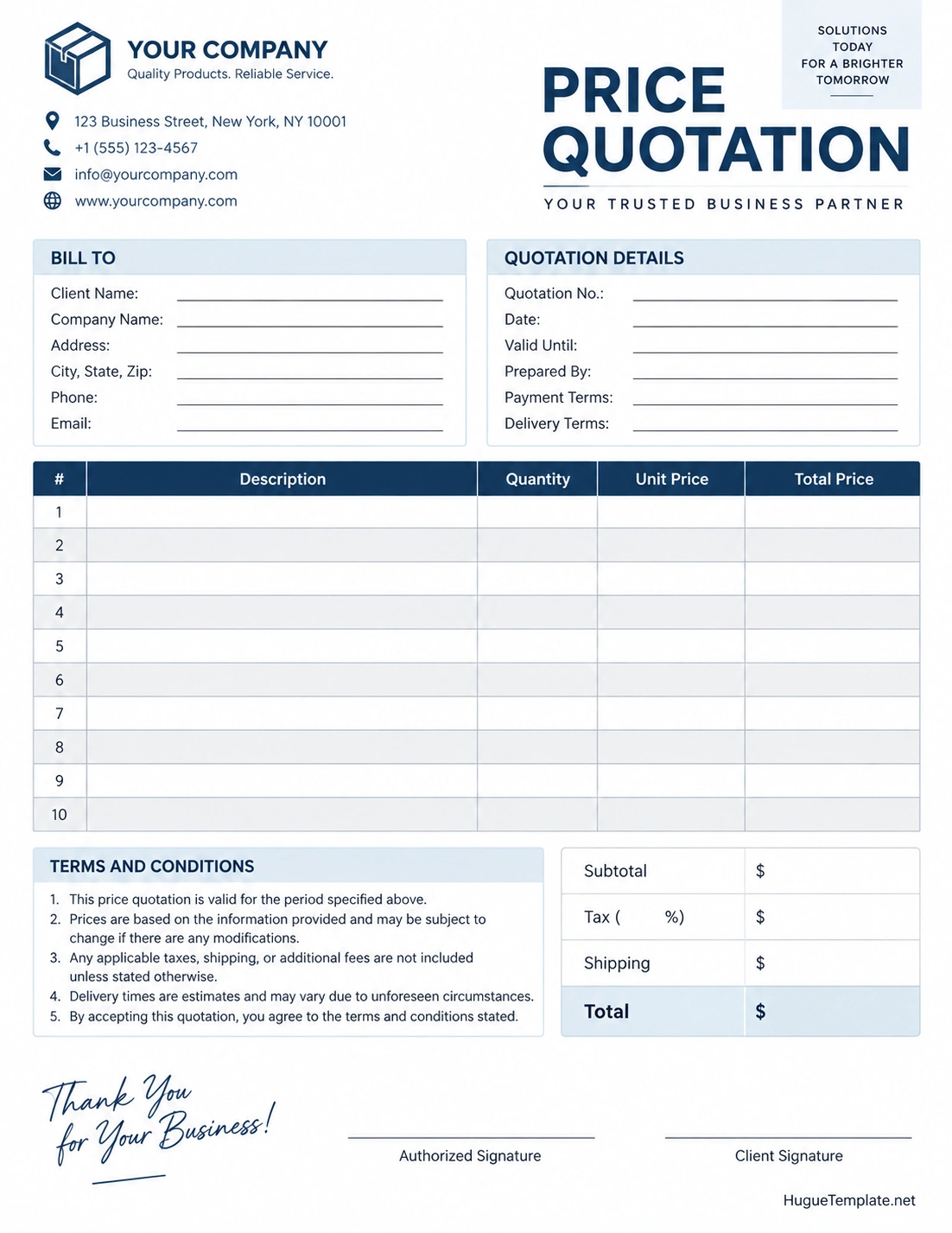
A printable quotation template can include sections for seller information, customer details, quotation information, itemized products or services, terms and conditions, totals, and authorization or acceptance.
Templates can also help businesses maintain consistency across multiple quotations. However, each quote should be reviewed and customized before it is sent.
Price Quotation Checklist
Before sending a quotation, use this checklist to review the document:
- Seller information is correct.
- Customer information is correct.
- Quotation number is included.
- Quotation date is included.
- Validity period is stated.
- Products or services are clearly described.
- Quantities are correct.
- Unit prices are correct.
- Subtotal is correct.
- Taxes and additional charges are identified.
- Discounts are shown where applicable.
- Final total is accurate.
- Payment terms are clearly stated.
- Delivery terms are explained.
- Important exclusions and conditions are included.
- Contact information is easy to find.
- The final document has been proofread.
Final Thoughts
A price quotation is an important business document for communicating proposed pricing, products, services, and transaction terms before a sale is finalized. A well-organized quotation gives customers a clearer understanding of what they will receive and what they are expected to pay.
For sellers, a detailed quote provides a professional record of the proposed transaction and helps establish expectations about pricing, scope, payment, and delivery. Clear validity periods and well-defined terms can also help businesses manage changing costs and avoid misunderstandings.
Whether you are quoting a single product, a service package, or a larger project, a professional price quotation template can make the process faster and more consistent. The most effective quotation is one that is accurate, transparent, easy to read, and tailored to the specific transaction.
Download: Price Quotation Template
