A production schedule is a structured plan that shows what products need to be manufactured, when production should take place, and which resources are required to complete the work. It helps businesses coordinate materials, labor, equipment, production capacity, and delivery deadlines in an organized way.
For manufacturers, having a clear production schedule can make the difference between an organized workflow and a process filled with delays, bottlenecks, and unused resources. By planning production activities in advance, businesses can align manufacturing output with customer demand while making better use of available resources.
A production schedule can be as simple as a printable worksheet or as detailed as a manufacturing planning system connected to inventory, purchasing, and production management software. Regardless of the format, the goal is the same: create a practical timeline for completing production efficiently.
What Is a Production Schedule?
A production schedule is a detailed plan that organizes manufacturing activities over a specific period. It identifies the products or orders that need to be completed and assigns planned production dates, quantities, resources, equipment, and other requirements.
The schedule translates production requirements into an actionable sequence of activities. Instead of simply knowing how many products must be manufactured, production teams can determine what should be produced first, what resources are needed, and when each order should be completed.
Depending on the organization, a production schedule may cover a single day, several days, a week, a month, or a longer planning period.
Why Is a Production Schedule Important?
Manufacturing involves many moving parts. Materials must be available, employees need to be scheduled, machines must have sufficient capacity, and finished products need to be completed in time to meet customer requirements.
A production schedule brings these activities together into one organized plan.
Helps Meet Customer Demand
Production planning allows manufacturers to coordinate output with expected customer orders. By understanding what needs to be produced and when it is required, the business can establish realistic production priorities.
Reduces Production Delays
A schedule can identify potential timing conflicts before they become major problems. If multiple orders require the same machine or production team, planners can arrange the sequence to reduce unnecessary waiting.
Improves Resource Utilization
Production scheduling helps businesses allocate available labor, materials, machinery, and work centers more effectively. Better coordination can reduce idle time and help prevent particular resources from becoming overloaded.
Reduces Waste
When production is coordinated with demand and material availability, businesses can reduce unnecessary production, excess inventory, and avoidable material waste.
Supports On-Time Delivery
A realistic production schedule gives teams a timeline for completing orders. This can help production and logistics teams coordinate their activities around customer delivery requirements.
What Information Does a Production Schedule Include?
The information included in a production schedule depends on the complexity of the manufacturing process. A basic schedule can contain only the essential production details, while a detailed schedule may include extensive resource and capacity information.
Common fields include:
- Product name
- Product or item code
- Customer or sales order number
- Order quantity
- Planned start date
- Planned completion date
- Production priority
- Work center or machine
- Required materials
- Assigned labor or production team
- Production status
- Special instructions
- Quality control requirements
- Additional notes
Key Components of a Production Schedule
Production Orders
The schedule should identify the products or orders that need to be manufactured. Each item can be assigned an order number or product code to make tracking easier.
Production Quantities
The required quantity tells the production team how many units need to be completed. Accurate quantities help planners determine the expected workload and material requirements.
Start and Completion Dates
Planned start and end dates establish the expected production window. These dates can be coordinated with material availability, machine capacity, staffing, and customer delivery commitments.
Resources
Resources may include raw materials, components, employees, machines, tools, workstations, and production facilities. Identifying these requirements helps planners determine whether the planned schedule is realistic.
Production Status
A status field can indicate whether an order is scheduled, waiting, in progress, completed, delayed, or otherwise affected by an operational issue.
Types of Production Schedules
Different manufacturing environments may require different scheduling approaches. The appropriate method depends on production volume, product variety, demand patterns, and operational constraints.
Daily Production Schedule
A daily production schedule focuses on activities planned for a single working day. It can be useful for production teams that need a detailed list of tasks, quantities, machines, and priorities for each shift.
Weekly Production Schedule
A weekly production schedule provides a broader view of manufacturing activities. It can help supervisors coordinate orders, staffing, materials, and equipment across several production days.
Monthly Production Schedule
A monthly schedule provides a longer planning horizon. It can be useful for coordinating larger production requirements, purchasing needs, staffing levels, and anticipated customer demand.
Master Production Schedule
A master production schedule, often called an MPS, provides a higher-level plan for what products should be produced and when. It can serve as an important connection between demand planning and detailed production activities.
How to Create a Production Schedule
1. Identify Customer Orders and Demand
Start by determining what products need to be manufactured and the quantities required. Review customer orders, forecasts, inventory levels, and delivery commitments as appropriate.
2. Determine Production Priorities
Not every order necessarily has the same urgency. Establish priorities based on customer deadlines, production requirements, material availability, and business needs.
3. Check Material Availability
Before scheduling production, verify that the necessary raw materials and components are available or expected to arrive in time. A production schedule that ignores material availability can create avoidable delays.
4. Review Machine and Equipment Capacity
Determine which machines, work centers, and tools are required. Check whether the planned workload exceeds available capacity during the selected production period.
5. Allocate Labor
Identify the employees or teams required for each production activity. Consider working hours, shifts, skills, availability, and other staffing constraints.
6. Establish the Production Sequence
Arrange production orders in a logical sequence. The sequence may depend on customer deadlines, setup requirements, machine availability, material constraints, or production efficiency.
7. Assign Start and End Dates
Give each production order a realistic production window. Avoid creating a schedule that assumes every resource will always operate at maximum capacity without interruptions.
8. Add Buffer Time
Production can be affected by machine maintenance, material shortages, quality issues, staffing changes, or unexpected orders. Where appropriate, include reasonable buffer time to make the schedule more resilient.
9. Review and Publish the Schedule
Before releasing the schedule to the production team, review the complete plan for conflicts, missing materials, unrealistic deadlines, and overloaded resources.
10. Monitor and Update
A production schedule should not necessarily remain unchanged. Actual production performance should be compared with the plan, and adjustments should be made when conditions change.
Production Scheduling vs. Production Planning
Production planning and production scheduling are closely related but focus on different levels of manufacturing management.
Production planning generally determines what resources and capabilities are needed to meet expected demand. It can involve decisions about materials, labor, capacity, inventory, and production requirements.
Production scheduling takes those requirements and organizes specific production activities into a sequence or timeline. It answers practical questions such as what should be produced, when it should be produced, and which resources should be used.
In simple terms, production planning establishes the broader requirements, while production scheduling turns those requirements into an actionable timetable.
Tips for Creating an Effective Production Schedule
A production schedule is most useful when it reflects actual operating conditions rather than simply presenting an ideal timeline.
- Use realistic production times.
- Consider machine capacity and setup times.
- Confirm material availability before scheduling work.
- Prioritize orders based on clearly defined criteria.
- Keep production information centralized.
- Allow reasonable flexibility for unexpected problems.
- Review production progress regularly.
- Communicate schedule changes quickly.
- Track delayed orders and identify their causes.
- Update the schedule when demand or capacity changes.
Common Production Scheduling Problems
Overloaded Resources
One common problem occurs when too many production orders are assigned to the same machine, work center, or team during the same period. Reviewing capacity before finalizing the schedule can help identify these conflicts.
Material Shortages
A production order may be scheduled even though one or more required materials are unavailable. Coordinating production scheduling with inventory and purchasing information can reduce this problem.
Unrealistic Deadlines
Schedules can become unreliable when completion dates are based on ideal conditions rather than realistic production capacity. Actual processing times, setup times, maintenance, and other constraints should be considered.
Frequent Schedule Changes
Constant changes can make it difficult for production teams to maintain a stable workflow. While adjustments are sometimes necessary, planners should identify recurring causes of disruption and address them where possible.
Poor Communication
A schedule is only useful when the people responsible for production can access and understand it. Changes should be communicated clearly to supervisors, operators, material coordinators, and other relevant teams.
Benefits of Using a Production Schedule Template
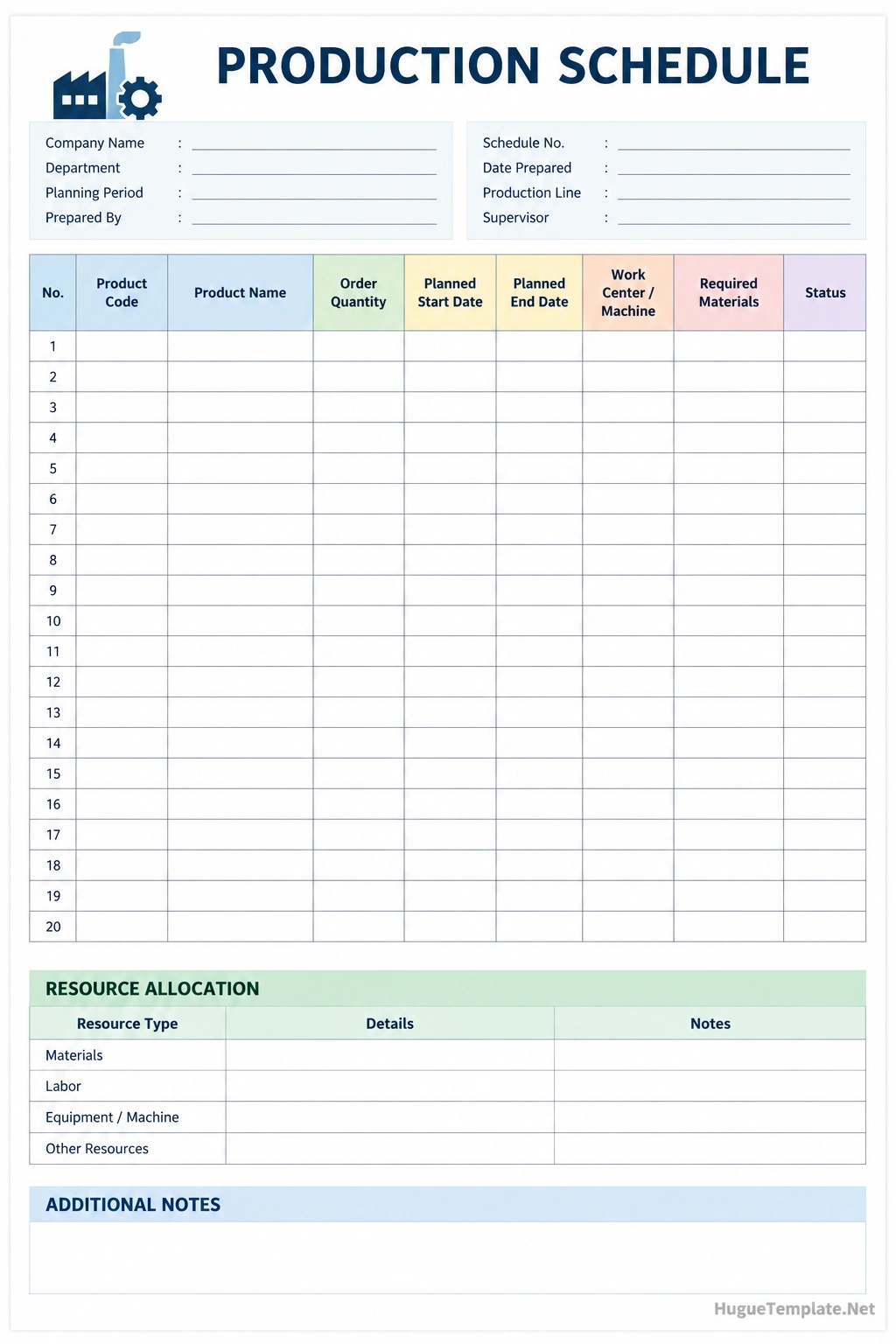
A production schedule template provides a reusable structure for organizing manufacturing activities. Instead of designing a new schedule from scratch, production planners can start with predefined fields and modify them according to the needs of the business.
A well-designed template can help organize:
- Production orders
- Product quantities
- Production dates
- Machines and work centers
- Materials
- Resource allocation
- Production status
- Additional instructions
A printable template can be especially useful for teams that rely on physical production boards, shift meetings, planning sessions, or printed work instructions. Digital versions can also be adapted into spreadsheets or production management systems.
How to Improve a Production Schedule Over Time
Creating the initial schedule is only one part of effective production management. Businesses should also review actual production performance and use the results to improve future schedules.
Compare planned production times with actual completion times. Look for recurring delays, material shortages, machine constraints, staffing issues, and other causes of schedule variance.
Over time, these observations can help planners create more realistic production times and identify opportunities to improve capacity utilization, workflow sequencing, and delivery performance.
Frequently Asked Questions About Production Schedules
What is the purpose of a production schedule?
The purpose of a production schedule is to organize manufacturing activities by determining what should be produced, when it should be produced, and which resources are required. It helps coordinate production with demand, capacity, materials, and delivery requirements.
What should a production schedule include?
A production schedule commonly includes product information, order quantities, planned start and completion dates, required materials, machines or work centers, resources, production status, and notes.
How often should a production schedule be updated?
The appropriate frequency depends on the manufacturing environment. Some businesses may update schedules daily or by shift, while others may work with weekly or monthly planning cycles. Schedules should be updated when significant changes affect production capacity, demand, materials, or deadlines.
Can a production schedule be created in Excel?
Yes. A spreadsheet can be used to create a production schedule, particularly for smaller operations or teams that do not require specialized manufacturing software. More complex manufacturing environments may benefit from dedicated production planning or manufacturing management systems.
What is the difference between a production schedule and a work schedule?
A production schedule focuses primarily on manufacturing activities, orders, quantities, timing, materials, and production resources. A work schedule generally focuses on assigning people to specific shifts or working hours. The two can be coordinated but serve different purposes.
Conclusion
A production schedule provides a practical framework for organizing manufacturing activities and coordinating the resources needed to complete production. By connecting customer demand with materials, labor, equipment, production capacity, and delivery dates, businesses can create a clearer and more manageable manufacturing workflow.
An effective schedule should be realistic, easy to understand, and flexible enough to accommodate changes. Regular monitoring and updates can help production teams respond to unexpected issues while maintaining focus on important customer and operational requirements.
Whether you manage a small production operation or a larger manufacturing environment, a well-organized production schedule template can provide a useful starting point for planning orders, allocating resources, tracking progress, and improving production coordination.
Download: Production Schedule Template
