A Sales Invoice is an important business document used to formally record the sale of goods or services and request payment from a customer. It provides the buyer with a clear summary of what was purchased, how much it costs, when payment is due, and how the transaction should be paid.
For sellers, a sales invoice is more than a request for payment. It can become an important record for accounts receivable, bookkeeping, inventory management, tax reporting, and financial documentation. For buyers, it provides evidence of a purchase and a useful reference for accounting and expense tracking. A clear and accurate invoice helps both parties maintain an organized record of the transaction.
What Is a Sales Invoice?
A Sales Invoice is a document issued by a seller to a customer after or in connection with a sale. It lists the products or services provided, quantities, prices, applicable discounts or taxes, the total amount due, and payment terms.
A sales invoice can be used by businesses of many sizes, from freelancers and small online stores to wholesalers, manufacturers, retailers, agencies, and service providers.
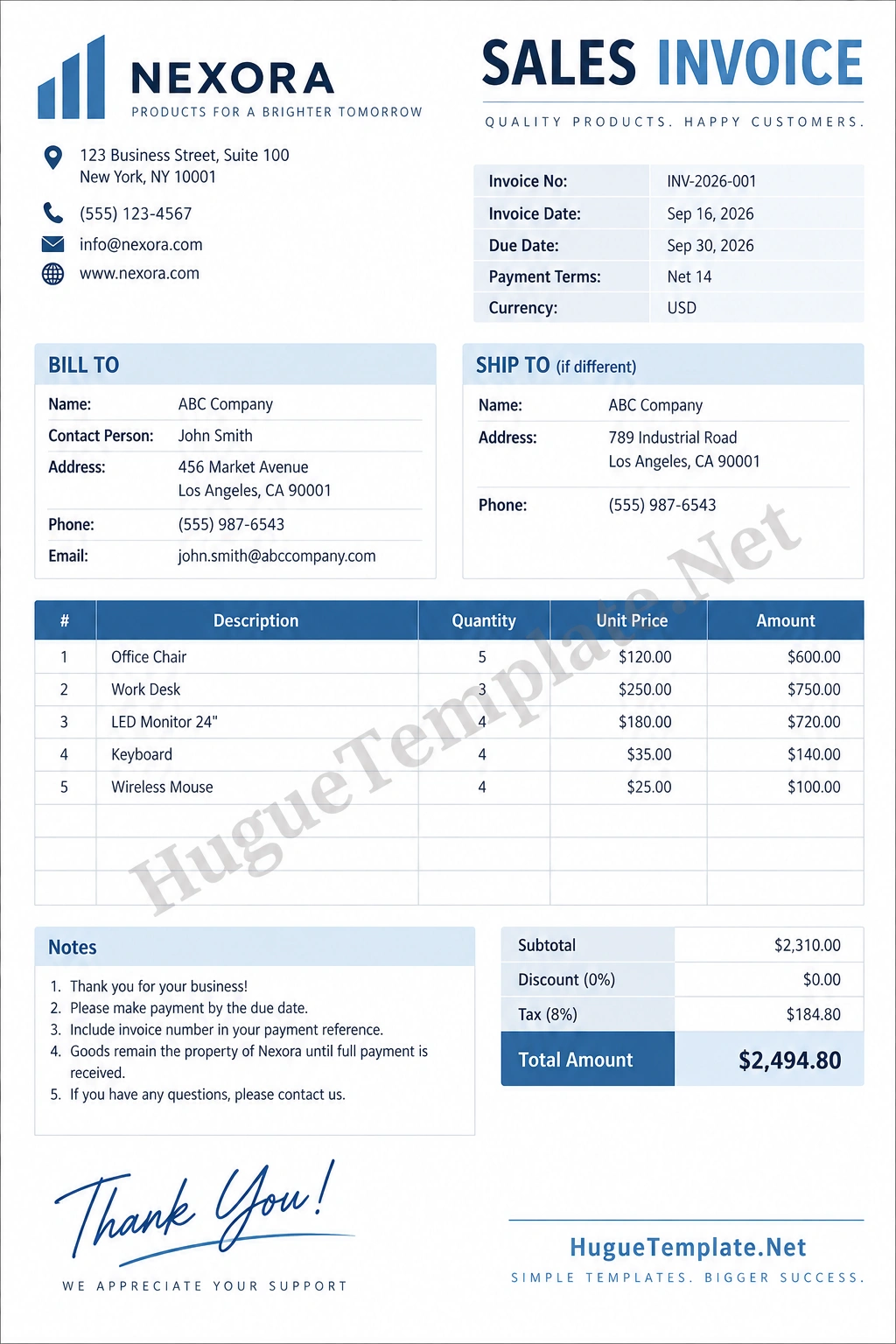
A typical sales invoice may contain:
- Seller information: Business name, address, contact information, and applicable registration details.
- Customer information: Customer or company name, billing address, and contact details.
- Invoice number: A unique identifier for the transaction.
- Invoice date: The date the invoice was issued.
- Due date: The date payment is expected.
- Product or service details: A description of what was sold.
- Quantity: The number of units or amount of service provided.
- Unit price: The price for each unit or service.
- Subtotal: The amount before discounts and taxes.
- Discounts and taxes: Applicable adjustments to the transaction.
- Total amount due: The final amount the customer is expected to pay.
- Payment instructions: Accepted payment methods and relevant account information.
Why Is a Sales Invoice Important?
A well-prepared invoice creates a clear written record of a commercial transaction. It allows the seller to communicate exactly what the customer is being charged for and provides a reference that can be used by both parties after the sale.
Invoices also support day-to-day financial administration. Businesses can use invoice numbers and dates to organize accounts receivable, track outstanding balances, reconcile payments, and maintain transaction records.
Depending on the jurisdiction and circumstances, invoices may also support tax and audit documentation. The exact legal and tax requirements vary, so businesses should follow the rules applicable to their location and industry.
Other practical benefits include:
- Creating a professional payment request.
- Documenting products or services sold.
- Making customer billing easier to understand.
- Supporting bookkeeping and financial reconciliation.
- Helping track unpaid customer balances.
- Providing transaction records for internal review.
- Supporting applicable tax and accounting documentation.
- Providing evidence of agreed transaction details when questions arise.
What Should a Sales Invoice Include?
Seller Details
Clearly identify the business or individual issuing the invoice. Include the business name, address, phone number, email address, and other information required for the transaction or applicable regulations.
Including recognizable business information also makes it easier for customers to confirm who issued the invoice and how to contact the seller.
Customer Details
Include the customer’s name and billing information. For business customers, use the appropriate company name and billing address. If goods are shipped to a different location, a separate shipping address can be included.
Invoice Number and Dates
Every invoice should have a unique invoice number or another suitable identifier. Consistent numbering makes invoices easier to locate and helps businesses maintain organized accounting records.
The invoice date identifies when the document was issued, while the due date communicates when payment is expected.
Itemized Products or Services
List each product or service clearly. Include descriptions, quantities, unit prices, and line-item amounts. Detailed descriptions can help prevent confusion, particularly when a customer purchases several products or services.
How to Create a Sales Invoice
Creating a sales invoice is straightforward when the required transaction information is organized beforehand. A consistent invoicing process can also reduce errors and make bookkeeping easier.
1. Identify the Seller and Customer
Enter the correct seller and customer information. Double-check names, addresses, and contact details before issuing the document.
2. Assign an Invoice Number
Give the invoice a unique number according to your business’s numbering system. A sequential numbering system can make it easier to identify missing or duplicate invoices.
3. Add Invoice and Due Dates
Enter the issue date and payment due date. If you offer payment terms such as Net 15 or Net 30, make the terms clear.
4. List the Items Sold
Enter each product or service as a separate line when appropriate. Include the quantity, unit price, and line total.
5. Calculate the Subtotal
Add the line-item amounts to determine the subtotal before discounts, taxes, shipping charges, or other applicable adjustments.
6. Apply Discounts and Taxes
Enter any agreed discounts and applicable taxes separately. Keeping these amounts visible makes the invoice easier for customers to review.
7. Calculate the Final Total
Calculate the final amount due after all applicable additions and deductions. Review the calculations carefully before sending the invoice.
8. Add Payment Instructions
Explain how the customer can pay. You may include bank transfer information, online payment options, credit card instructions, checks, or other accepted methods.
Sales Invoice Example
Suppose a business sells office equipment to a corporate customer. The invoice may list two laptops, five wireless mice, five keyboards, two monitors, and three USB-C hubs.
Each product would appear as an individual line item with its quantity and unit price. The line amounts would then be added to calculate the subtotal. If the seller provides a discount and must collect applicable sales tax, those amounts can be shown separately before calculating the final amount due.
This itemized format gives the customer a clear explanation of how the total was calculated and gives the seller a useful record for accounting purposes.
Sales Invoice vs. Receipt
A Sales Invoice and a receipt are related but serve different purposes. An invoice generally communicates the amount owed and requests payment. A receipt generally confirms that payment has been received.
For example, a seller might issue an invoice when goods are sold on credit. Once the customer pays, the seller may provide a receipt or record the payment against the invoice.
Businesses should use documentation appropriate to their transaction process and applicable accounting requirements.
Sales Invoice vs. Purchase Order
A purchase order is generally created by the buyer to communicate an intention to purchase specified goods or services under stated terms. A Sales Invoice is generally issued by the seller to request payment for the goods or services supplied.
The two documents can work together. A purchase order may establish what the customer intends to buy, while the invoice documents the seller’s billing for the resulting transaction.
What Are Common Sales Invoice Payment Terms?
Payment terms explain when and how a customer should pay. Clear terms can help reduce uncertainty and improve cash-flow management.
Common payment terms include:
- Due on receipt: Payment is requested when the customer receives the invoice.
- Net 7: Payment is generally due within seven days.
- Net 15: Payment is generally due within fifteen days.
- Net 30: Payment is generally due within thirty days.
- Partial payment: The customer pays an agreed portion before the remaining balance is due.
- Installments: The total amount is divided into multiple scheduled payments.
Businesses should choose payment terms that are appropriate for their customer relationships and clearly communicate those terms before or at the time of the transaction.
Tips for Creating a Professional Sales Invoice
- Use a consistent format: Keep your invoice layout consistent across customers.
- Make important information easy to find: Highlight the invoice number, due date, and total amount due.
- Itemize charges: Give customers enough detail to understand the transaction.
- Double-check calculations: Verify quantities, prices, discounts, taxes, and totals.
- Use clear payment instructions: Make it obvious how and where payment should be sent.
- Keep records: Store issued invoices and related payment information securely.
- Send invoices promptly: Timely invoicing can support more predictable accounts receivable.
- Track outstanding balances: Monitor unpaid invoices and follow up according to your business process.
Common Sales Invoice Mistakes to Avoid
Incorrect customer information is a common invoicing problem. An incorrect business name, billing address, or contact can delay processing and create unnecessary follow-up work.
Another mistake is failing to include a unique invoice number. Without a reliable identifier, finding a specific invoice can become difficult as transaction volume increases.
Businesses should also check calculations carefully. A small error in quantity, unit price, discount, or tax can result in an incorrect amount due.
Vague product or service descriptions can create confusion as well. Whenever practical, describe what was sold clearly enough that the customer can compare the invoice with the original order or agreement.
Using a Sales Invoice Template
A Sales Invoice Template provides a ready-made structure for preparing professional invoices. Instead of designing every invoice from scratch, businesses can enter the relevant transaction information into predefined fields.
A printable sales invoice template can be useful for retailers, wholesalers, service providers, freelancers, manufacturers, online sellers, and small businesses. A reusable template can also help maintain consistent branding and formatting across customer transactions.
When selecting a template, look for sections for seller and customer information, invoice details, itemized charges, totals, payment terms, and notes. The template should also provide enough space for the products or services being sold.
Digital Sales Invoices
Digital invoicing can make the billing process faster and easier to organize. Businesses can create invoices using accounting software, spreadsheets, word-processing applications, or dedicated invoicing platforms.
Digital invoices are particularly useful when businesses need to send documents by email, search historical records, track payment status, or integrate invoices with accounting workflows.
Regardless of the format, businesses should maintain appropriate records and protect customer and financial information. Follow applicable requirements for electronic records, privacy, tax documentation, and record retention.
How to Organize Sales Invoice Records
A consistent recordkeeping system can make invoicing much easier to manage. Businesses can organize invoices by customer, invoice number, month, project, or accounting period.
It can also be useful to track the status of each invoice, such as draft, sent, partially paid, paid, overdue, or canceled. This helps businesses identify outstanding balances and reconcile payments.
Keep supporting documents, such as purchase orders, delivery records, contracts, and payment confirmations, according to your business’s accounting and record-retention practices.
Frequently Asked Questions About Sales Invoices
What is the purpose of a Sales Invoice?
A Sales Invoice documents a sale and communicates the amount a customer is expected to pay for goods or services. It can also support bookkeeping, accounts receivable, tax documentation, and transaction records.
What information should a Sales Invoice contain?
A Sales Invoice commonly contains seller and customer information, an invoice number, invoice date, due date, itemized products or services, quantities, prices, discounts, taxes, total amount due, and payment instructions.
Is a Sales Invoice the same as a bill?
The terms can overlap in everyday business language. In many contexts, an invoice is a formal document issued by a seller that details a transaction and requests payment from the buyer.
Can a Sales Invoice be used for services?
Yes. A sales invoice can document services as well as physical products. Instead of product quantities, a service invoice may list hours, project fees, service units, milestones, or other billing measures.
How should invoice numbers be assigned?
Businesses can use a consistent numbering system, such as sequential numbers or a system incorporating dates or customer codes. The important consideration is that each invoice can be uniquely identified and tracked.
Conclusion
A Sales Invoice is an essential business document for recording sales and communicating payment obligations to customers. By clearly listing the products or services sold, prices, quantities, taxes, payment terms, and total amount due, an invoice creates a useful reference for both the buyer and seller.
A professional invoicing process can also support accounts receivable, bookkeeping, financial reporting, and applicable tax documentation. Using a structured Sales Invoice Template makes it easier to create consistent invoices while reducing the amount of time spent formatting each document.
Whether you operate a small business, sell products online, provide professional services, or manage a larger commercial operation, keeping sales invoices accurate, clear, and well organized can make everyday financial administration much easier.
