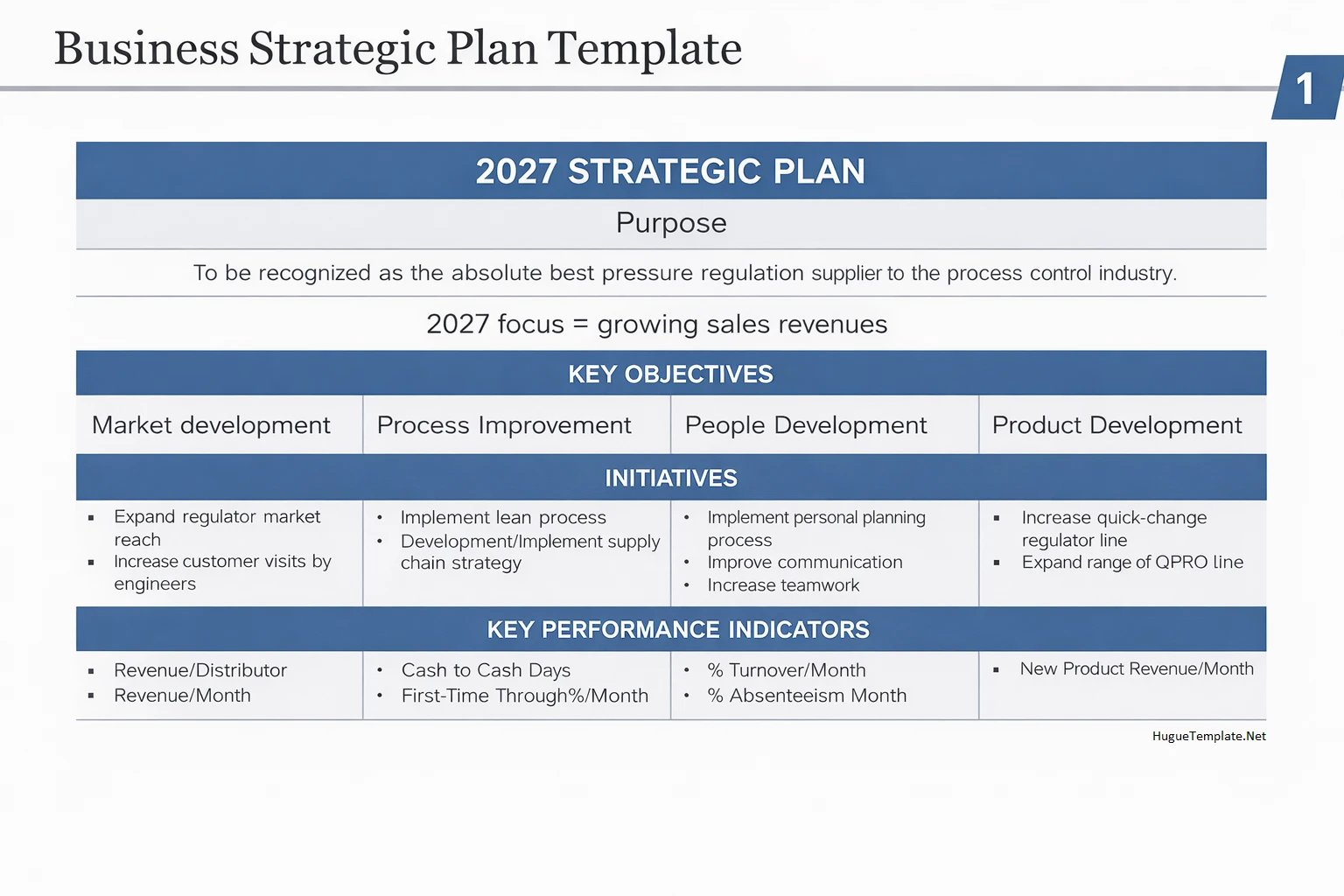
In the fast-paced and ever-evolving business landscape, having a strategic plan in place is crucial for long-term success.
A business strategic plan serves as a roadmap that provides direction by setting clear goals, identifying opportunities, and mitigating risks. It aligns the entire organization towards a common vision, ensuring resources are allocated effectively to achieve set objectives and stay ahead of market changes. The key outcomes of a well-developed strategic plan include improved decision-making, enhanced resource allocation, greater team alignment, proactive risk management, and a significant competitive advantage.
What Is a Business Strategic Plan?
A business strategic plan is a comprehensive document that outlines a company’s goals, objectives, and strategies for achieving them. It serves as a roadmap for the organization, guiding decision-making, resource allocation, and overall direction.
A strategic plan typically includes an analysis of the current state of the business, a vision for the future, specific goals and objectives, action plans to achieve those goals, and metrics to measure success.
Why Every Successful Business Needs a Strategic Plan?
1. Improved Decision-Making
A strategic plan provides a framework for making informed decisions that are aligned with the company’s goals and objectives. By having a clear roadmap in place, business leaders can evaluate different options, assess risks and rewards, and make decisions that are in the best interest of the organization.
Improved decision-making in a strategic plan involves gathering relevant data, insights, and information to inform strategic choices and actions. By conducting market research, competitor analysis, financial modeling, and scenario planning, businesses can make evidence-based decisions that are grounded in data and analysis. This data-driven approach reduces uncertainty, minimizes biases, and enhances the quality of decision-making.
Moreover, improved decision-making in a strategic plan requires businesses to involve key stakeholders in the decision-making process, including employees, managers, customers, suppliers, and investors. By soliciting input, feedback, and perspectives from diverse sources, companies can make more inclusive, collaborative, and effective decisions that reflect the interests and needs of all stakeholders. This participatory approach fosters engagement, ownership, and alignment with the strategic objectives.
In addition, improved decision-making in a strategic plan involves setting decision-making criteria, frameworks, and processes that guide how decisions are made and implemented. By establishing clear guidelines, roles, and responsibilities for decision-makers, businesses can streamline decision-making, reduce delays, and ensure accountability. This structured approach promotes consistency, transparency, and agility in decision-making across the organization.
Furthermore, improved decision-making in a strategic plan requires businesses to monitor and evaluate the impact of decisions on the company’s performance, progress, and results. By tracking key performance indicators (KPIs), metrics, and milestones, companies can assess the effectiveness of decisions, identify areas for improvement, and make adjustments as needed to achieve the desired outcomes. This continuous feedback loop enables businesses to learn from past decisions, adapt to changing circumstances, and optimize decision-making processes over time.
2. Enhanced Resource Allocation
Effective resource allocation is crucial for the success of any business. A strategic plan helps companies allocate resources such as capital, time, and manpower in a way that maximizes efficiency and effectiveness. By prioritizing key initiatives and projects, businesses can optimize their resources and achieve their goals more effectively.
Enhanced resource allocation in a strategic plan involves identifying and prioritizing resource needs based on the company’s strategic objectives and priorities. By aligning resource allocation with strategic goals, businesses can ensure that resources are allocated to initiatives that have the greatest impact on achieving success. This strategic alignment enables companies to focus their resources on high-priority projects, minimize waste, and maximize returns on investment.
Moreover, enhanced resource allocation in a strategic plan requires businesses to develop resource allocation strategies, processes, and tools that facilitate effective decision-making and oversight. By establishing resource allocation frameworks, budgeting guidelines, and performance metrics, companies can ensure that resources are allocated in a transparent, fair, and accountable manner. This governance structure promotes efficiency, accountability, and alignment with the company’s strategic goals.
In addition, enhanced resource allocation in a strategic plan involves monitoring and evaluating resource utilization, performance, and outcomes to assess the effectiveness of resource allocation decisions. By tracking resource allocation against budgeted targets, timelines, and deliverables, businesses can identify variances, inefficiencies, and opportunities for improvement. This data-driven approach enables companies to make informed decisions about reallocating resources, adjusting priorities, and optimizing resource utilization to achieve better results.
Furthermore, enhanced resource allocation in a strategic plan requires businesses to foster a culture of resource stewardship, collaboration, and innovation across the organization. By promoting transparency, accountability, and communication about resource allocation decisions, companies can build trust, engagement, and alignment with employees, managers, and stakeholders. This shared understanding of resource priorities and constraints enables teams to work together towards common goals,
3. Greater Team Alignment
A strategic plan ensures that all employees are aligned with the company’s vision, mission, and goals. By clearly communicating the strategic objectives and priorities, businesses can foster a sense of purpose and direction among their teams. This alignment leads to increased motivation, collaboration, and productivity across the organization.
Greater team alignment in a strategic plan involves communicating the company’s vision, mission, and goals to employees in a clear and compelling way. By articulating the why behind the strategic plan, businesses can inspire and engage employees, creating a shared sense of purpose and direction. This alignment fosters a culture of commitment, dedication, and passion for achieving the company’s strategic objectives.
Moreover, greater team alignment in a strategic plan requires businesses to involve employees in the strategic planning process, soliciting their input, feedback, and ideas for achieving the company’s goals. By empowering employees to contribute to the strategic plan, businesses can create a sense of ownership, accountability, and commitment among team members. This participatory approach builds trust, collaboration, and alignment with the strategic objectives across the organization.
In addition, greater team alignment in a strategic plan involves aligning individual goals and objectives with the company’s strategic priorities and initiatives. By cascading goals from the top down and aligning them with departmental and individual goals, businesses can ensure that everyone is working towards a common purpose. This alignment of goals promotes synergy, coordination, and teamwork among employees, driving collective performance and results.
Furthermore, greater team alignment in a strategic plan requires businesses to provide ongoing communication, feedback, and recognition to employees to keep them engaged and motivated. By celebrating successes, acknowledging achievements, and providing regular updates on progress towards goals, companies can sustain momentum, enthusiasm, and commitment among team members. This positive reinforcement reinforces the importance of alignment with the strategic plan and encourages continuous improvement and innovation.
4. Proactive Risk Management
By identifying potential risks and developing mitigation strategies, businesses can avoid costly mistakes and setbacks. A strategic plan enables companies to anticipate risks, assess their impact, and implement measures to minimize their effects. This proactive approach to risk management helps businesses navigate challenges and uncertainties with confidence.
Proactive risk management in a strategic plan involves conducting a thorough risk assessment to identify potential threats, vulnerabilities, and uncertainties that could impact the company’s ability to achieve its goals. By analyzing internal and external risks, assessing their likelihood and impact, and prioritizing them based on severity, businesses can develop risk mitigation strategies that address the most critical risks first. This prioritization ensures that resources are allocated effectively to manage risks that pose the greatest threat to the company’s success.
Moreover, proactive risk management in a strategic plan requires businesses to develop contingency plans, response strategies, and crisis management protocols to address potential risks and disruptions. By preparing for various scenarios, developing action plans, and training employees on how to respond to emergencies, companies can minimize the impact of adverse events and ensure business continuity. This readiness enables businesses to react quickly, decisively, and effectively to unforeseen challenges, maintaining stability and resilience in the face of uncertainties.
In addition, proactive risk management in a strategic plan involves monitoring and evaluating risks on an ongoing basis to stay ahead of emerging threats and changing circumstances. By establishing risk management processes, protocols, and controls, businesses can identify early warning signs, assess potential impacts, and take proactive measures to mitigate risks before they escalate. This vigilance and responsiveness enable companies to adapt to new risks, trends, and challenges, ensuring that they remain agile, adaptable, and competitive in dynamic market environments.
Furthermore, proactive risk management in a strategic plan requires businesses to communicate risk management strategies, responsibilities, and expectations to all stakeholders, including employees, managers, suppliers, customers, and investors. By promoting a culture of risk awareness, transparency, and accountability, companies can build trust, credibility, and confidence in their ability to manage risks effectively. This open communication fosters collaboration, engagement, and shared commitment to proactively managing risks and uncertainties across the organization.
Key Elements of Strategic Planning
Strategic planning involves several key elements that are essential for creating a comprehensive and effective strategic plan. These elements include:
1. SWOT Analysis
SWOT analysis is a strategic planning tool that helps businesses identify their strengths, weaknesses, opportunities, and threats. By analyzing internal and external factors that impact the company’s performance and competitive position, businesses can develop strategies that capitalize on strengths, address weaknesses, seize opportunities, and mitigate threats. SWOT analysis provides a holistic view of the business environment, guiding decision-making, resource allocation, and strategic priorities.
2. Market Research
Market research is essential for understanding customer needs, preferences, and behaviors, as well as market trends, competitor activities, and industry dynamics. By gathering data, insights, and information on market conditions, businesses can identify opportunities for growth, innovation, and differentiation. Market research informs strategic planning by providing a fact-based foundation for decision-making, resource allocation, and competitive positioning. By staying informed about market trends, customer expectations, and competitor strategies, businesses can anticipate changes, capitalize on opportunities, and outperform rivals.
3. Goal Setting
Establishing clear, specific, and measurable goals is fundamental to strategic planning. Goals provide a roadmap for success, guiding decision-making, resource allocation, and performance evaluation. By setting SMART goals that are specific, measurable, achievable, relevant, and time-bound, businesses can create a clear direction for the organization and motivate employees to work towards a common objective. Goal setting enables businesses to track progress, assess performance, and make adjustments as needed to achieve desired outcomes.
4. Action Planning
Developing detailed action plans and initiatives is essential for translating strategic goals into actionable steps. Action planning involves identifying specific tasks, timelines, responsibilities, and resources needed to achieve the company’s goals. By breaking down goals into manageable actions, businesses can create a roadmap for implementation, monitor progress, and ensure accountability. Action planning enables companies to execute strategic initiatives effectively, align activities with priorities, and optimize resource utilization for maximum impact.
5. Performance Metrics
Defining key performance indicators (KPIs) is critical for measuring the success and progress of the strategic plan. KPIs allow businesses to track performance, evaluate outcomes, and make data-driven decisions. By establishing metrics that align with the company’s goals and objectives, businesses can assess the effectiveness of their strategies, identify areas for improvement, and optimize performance. Performance metrics provide a basis for evaluating progress, making informed decisions, and demonstrating the impact of the strategic plan on the company’s performance and results.
6. Communication Strategy
Ensuring that the strategic plan is effectively communicated to all stakeholders is essential for alignment, engagement, and commitment. A communication strategy involves sharing the strategic plan, goals, and objectives with employees, managers, customers, suppliers, investors, and partners. By using clear, consistent, and compelling messaging, businesses can create awareness, understanding, and buy-in for the strategic plan. A communication strategy fosters transparency, trust, and collaboration across the organization, ensuring that everyone is aligned with the company’s vision and working towards common goals.
7. Implementation Plan
Creating a detailed roadmap for implementing the strategic initiatives is crucial for translating the strategic plan into action. An implementation plan involves defining tasks, timelines, milestones, and responsibilities for executing the strategic initiatives. By developing a structured approach to implementation, businesses can ensure that activities are coordinated, resources are allocated effectively, and progress is monitored. An implementation plan enables companies to track progress, identify barriers, and make adjustments as needed to achieve the desired outcomes within the specified timeframe.
Step Strategic Planning Process
The strategic planning process typically involves several key steps that guide the development and implementation of the strategic plan. These steps include:
Step 1: Conduct a Situation Analysis
Assessing the current state of the business is essential for understanding internal capabilities, external challenges, and market dynamics. A situation analysis involves conducting a SWOT analysis, market research, competitor analysis, and performance evaluation. By analyzing strengths, weaknesses, opportunities, and threats, businesses can identify areas for improvement, set strategic priorities, and develop a roadmap for success.
Step 2: Define the Vision and Mission
Establishing a clear vision for the future of the company and defining its purpose and values is fundamental to strategic planning. By articulating the company’s vision and mission, businesses can create a sense of direction, inspire employees, and guide decision-making. A compelling vision and mission provide a North Star for the organization, shaping its culture, strategy, and priorities.
Step 3: Set Goals and Objectives
Establishing specific, measurable, achievable, relevant, and time-bound (SMART) goals is essential for translating the vision and mission into actionable steps. Goal-setting involves defining short-term and long-term objectives that align with the company’s strategic priorities. By setting clear goals, businesses can create a roadmap for success, motivate employees, and track progress towards achieving desired outcomes.
Step 4: Develop Strategies and Tactics
Identifying strategic initiatives and action plans is critical for achieving the company’s goals and objectives. Strategy development involves defining how the company will achieve its goals, what resources are needed, and who is responsible for implementation. By developing detailed strategies and tactics, businesses can create a roadmap for execution, monitor progress, and make adjustments as needed to ensure success.
Step 5: Implement the Plan
Executing the strategic initiatives and action plans is essential for turning the strategic plan into reality. Implementation involves assigning tasks, allocating resources, and monitoring progress towards achieving the company’s goals. By following the implementation plan, businesses can ensure that activities are coordinated, resources are utilized effectively, and progress is tracked. Implementation is a critical phase in the strategic planning process, as it determines the success ofthe plan and sets the foundation for monitoring and evaluating outcomes.
Step 6: Evaluate and Adjust
Continuously monitoring and evaluating the performance of the strategic plan is essential for assessing progress, identifying challenges, and making adjustments as needed. Evaluation involves tracking key performance indicators (KPIs), metrics, and milestones to measure the success of the strategic plan. By analyzing performance data, identifying trends, and comparing results to established targets, businesses can assess the effectiveness of their strategies, identify areas for improvement, and make adjustments to stay on track towards achieving their goals.
What Are the Risks of Not Having a Strategic Plan?
Lack of Direction
Without a strategic plan, businesses may lack a clear direction and purpose, leading to confusion, inefficiency, and missed opportunities. A lack of direction can result in haphazard decision-making, resource wastage, and an inability to capitalize on market trends.
Moreover, a lack of direction can create uncertainty, ambiguity, and disorganization within the organization. Without a roadmap for success, employees may lack clarity on the company’s goals, priorities, and expectations. This lack of direction can lead to misalignment, conflicts, and inefficiencies in decision-making, resource allocation, and performance management.
Additionally, a lack of direction can hinder growth, innovation, and competitiveness in the market. Without a strategic plan to guide decision-making and resource allocation, businesses may struggle to adapt to changing market conditions, capitalize on emerging opportunities, and differentiate themselves from competitors. This lack of strategic direction can impede progress, limit growth potential, and jeopardize long-term success.
Furthermore, a lack of direction can erode employee morale, motivation, and engagement. Without a clear sense of purpose and direction, employees may feel disconnected, disengaged, and uncommitted to the company’s goals and objectives. This lack of alignment can lead to low morale, high turnover, and reduced productivity, impacting overall performance and results.
Reactive Decision-Making
Businesses without a strategic plan may find themselves reacting to external events and market changes rather than proactively shaping their own future. Reactive decision-making can lead to missed opportunities, increased risks, and an inability to stay ahead of competitors.
Moreover, reactive decision-making can result in short-term thinking, opportunistic behaviors, and a firefighting mode within the organization. Without a strategic plan to guide decision-making, businesses may focus on immediate challenges, quick fixes, and short-term gains at the expense of long-term sustainability and growth. This reactive approach can lead to ad-hoc decisions, inconsistent priorities, and limited strategic vision.
Additionally, reactive decision-making can create a sense of urgency, stress, and chaos within the organization. Without a clear roadmap for success, employees may feel overwhelmed, uncertain, and unprepared to handle unexpected challenges and disruptions. This reactive mode of operation can lead to burnout, frustration, and disengagement among employees, impacting morale, performance, and results.
Furthermore, reactive decision-making can make businesses vulnerable to external shocks, competitive threats, and market disruptions. Without a strategic plan to anticipate risks, assess opportunities, and plan for contingencies, companies may struggle to adapt to changing circumstances, capitalize on emerging trends, and mitigate potential threats. This reactive posture can leave businesses exposed to risks, uncertainties, and vulnerabilities that could jeopardize their survival and success.
Inefficient Resource Allocation
Without a strategic plan, businesses may struggle to allocate resources effectively, leading to inefficiencies, redundancies, and missed opportunities. Effective resource allocation is crucial for maximizing the impact of investments and achieving long-term success.
Moreover, inefficient resource allocation can result in misalignment, duplication, and waste within the organization. Without a strategic plan to guide resource allocation decisions, businesses may spread resources too thin, invest in non-strategic initiatives, and overlook critical priorities. This lack of focus can lead to inefficiencies, redundancies, and missed opportunities for growth and innovation.
Additionally, inefficient resource allocation can create silos, turf wars, and conflicts over resource allocation within the organization. Without a strategic plan to prioritize resources based on strategic objectives, departments may compete for limited resources, hoard information, and resist collaboration. This lack of coordination can lead to inefficiencies, delays, and conflicts that hinder progress, innovation, and performance.
Furthermore, inefficient resource allocation can hinder accountability, transparency, and performance management within the organization. Without a clear process for allocating resources, tracking expenses, and evaluating outcomes, businesses may struggle to hold employees accountable for results, measure the return on investment, and optimize resource utilization. This lack of oversight can lead to budget overruns, missed targets, and suboptimal performance that impact the company’s bottom line and long-term viability.
Lack of Team Alignment
A lack of a strategic plan can result in misalignment among team members, leading to confusion, conflicts, and reduced productivity. Team alignment is essential for fostering collaboration, communication, and shared goals across the organization.
Moreover, a lack of team alignment can create silos, departmental rivalries, and communication breakdowns within the organization. Without a strategic plan to align goals and priorities across teams, departments may work in isolation, focus on narrow objectives, and overlook opportunities for synergy and collaboration. This lack of alignment can lead to duplication of efforts, inefficiencies, and missed opportunities for cross-functional cooperation and innovation.
Additionally, a lack of team alignment can erode trust, morale, and engagement among employees. Without a shared vision and common goals, team members may feel disconnected, disengaged, and demotivated to work towards a common purpose. This lack of alignment can lead to low team morale, high turnover, and reduced productivity, impacting overall performance and results.
Furthermore, a lack of team alignment can hinder communication, coordination, and decision-making within the organization. Without a strategic plan to guide cross-functional collaboration, teams may struggle to share information, align priorities, and work towards common objectives. This lack of alignment can lead to conflicts, misunderstandings, and delays in decision-making that impede progress, innovation, and performance.
Limited Growth Potential
Businesses without a strategic plan may struggle to grow and expand in a competitive market environment. A strategic plan provides a roadmap for growth, innovation, and diversification, enabling companies to capitalize on opportunities and achieve their full potential.
Moreover, a lack of a strategic plan can result in missed opportunities for growth, expansion, and market leadership. Without a clear direction and focused strategy, businesses may fail to identify emerging trends, customer needs, and competitive threats that could impact their growth potential. This lack of strategic vision can lead to missed opportunities for innovation, differentiation, and market leadership that hinder long-term success.
Additionally, a lack of a strategic plan can create uncertainty, indecision, and stagnation within the organization. Without a roadmap for success and a clear vision for the future, employees may lack motivation, direction, and purpose in their work. This lack of strategic alignment can lead to complacency, inertia, and resistance to change that limit growth potential, inhibit innovation, and jeopardize the company’s long-term viability.
Furthermore, a lack of a strategic plan can hamper strategic agility, adaptability, and responsiveness in a rapidly changing business environment. Without a roadmap for navigating uncertainties, capitalizing on opportunities, and mitigating risks, businesses may struggle to adapt to market shifts, customer preferences, and technological advancements. This lack of strategic foresight can leave companies vulnerable to competitive threats, disruptive forces, and industry changes that impact their growth potential and competitive advantage.
Business Strategic Plan Template – DOWNLOAD
